
 By Tort Law Team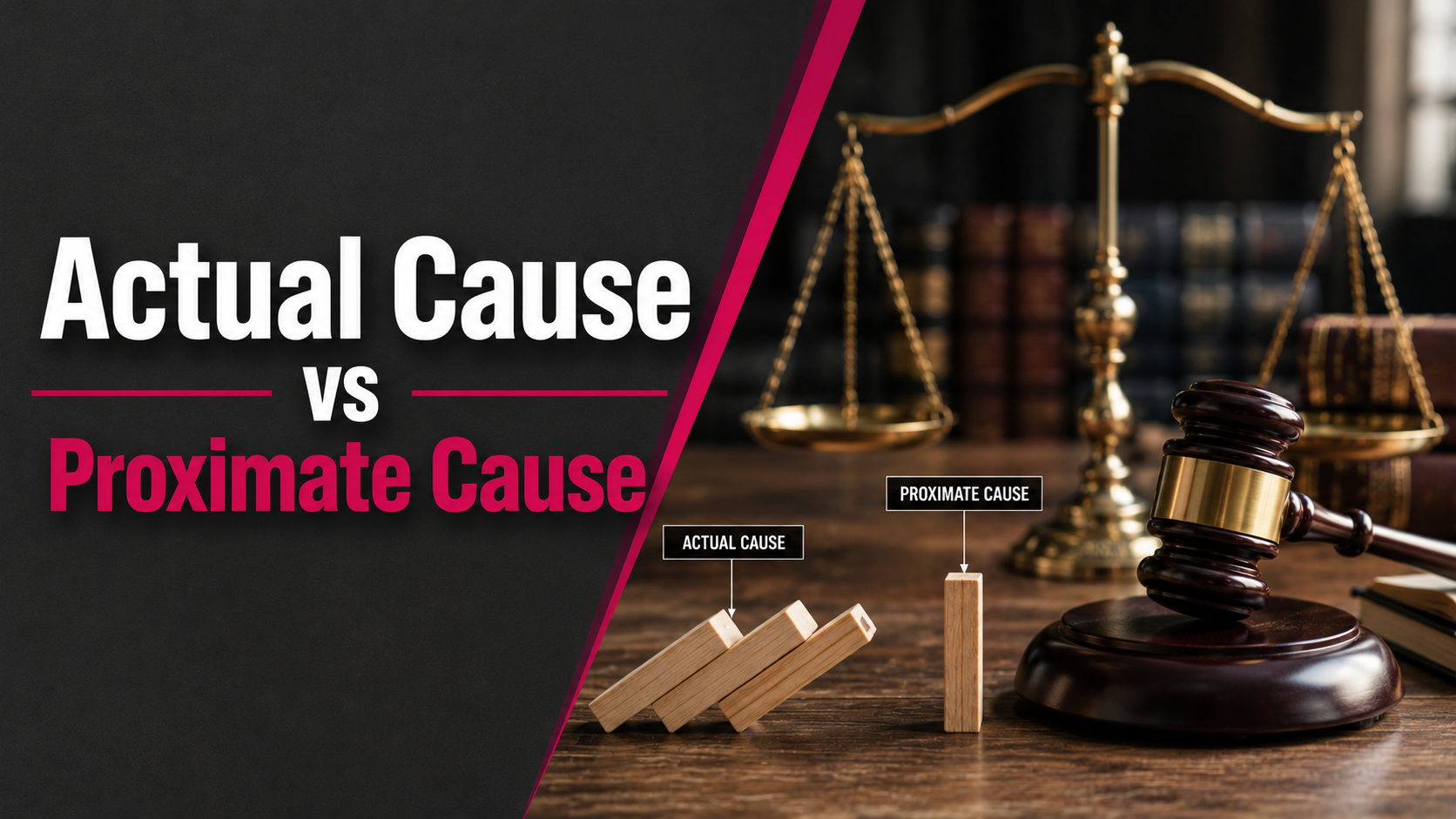
Imagine you are driving carefully through an intersection when another car runs a red light and hits you. Your injuries are clear, medical bills pile up, and you want the other driver held responsible. Yet in court, simply showing the crash happened is not enough. You must prove the driver’s actions legally caused your harm. This is where the distinction between actual cause and proximate cause becomes critical.
In personal injury and tort law, courts require both forms of causation before assigning personal injury liability. Without them, even a clear breach of the duty of care will not produce recovery for legal damages. This article breaks down actual cause vs proximate cause in plain language so injury victims, accident survivors, law students, and paralegals can see how courts decide who pays.
Understanding Negligence and the Role of Causation
Most personal injury claims rest on negligence. To win, a plaintiff must prove four core elements:
- The defendant owed a duty of care.
- The defendant breached that duty.
- The breach caused the plaintiff’s injuries (legal causation).
- The plaintiff suffered actual harm or legal damages.
Causation is often the most contested piece. Courts split it into two independent requirements: actual cause (also called cause in fact) and proximate cause (also called legal cause). Both must exist. Proving one without the other usually ends the claim.
Think of actual cause as the factual “yes, this action led to that injury” link. Proximate cause asks a policy question: is it fair and reasonable to hold this person responsible for these particular results? The law refuses to make someone pay for every remote ripple that can be traced back to their conduct.
What Is Actual Cause (Cause in Fact)?
Actual cause asks a straightforward counterfactual question. Would the injury have occurred if the defendant had acted differently? If the answer is no, actual cause exists.
Courts most often apply the but-for test. “But for” the defendant’s conduct, the harm would not have happened. In a typical car accident, but for the other driver running the red light, you would not have been struck. The driver’s action is therefore an actual cause of your injuries.
The Substantial Factor Test
Sometimes multiple forces combine and the pure but-for test becomes awkward. Two drivers may both speed through an intersection and collide with you at the same moment. Either collision alone might have caused the same harm. In these situations many courts switch to the substantial factor test. They ask whether the defendant’s conduct was a significant, non-trivial factor in producing the injury. If it was, actual cause is satisfied even if other causes also contributed.
Multiple Actual Causes
Nothing prevents more than one actual cause. A poorly maintained road, a distracted driver, and a defective tire can all be but-for causes of the same crash. Each can support liability against different defendants. The law simply requires that the defendant’s own conduct be one of those factual causes.
Limits of Actual Cause Alone
The but-for chain can stretch almost endlessly. But for the defendant being born, the accident would never have occurred. Courts refuse to follow the chain that far. That is why proximate cause exists: it cuts the chain at a point the law considers fair.
What Is Proximate Cause (Legal Cause)?
Proximate cause limits liability to harms that are closely connected to the defendant’s conduct in a way the law recognizes. The dominant modern test is foreseeability. A reasonable person in the defendant’s position should have anticipated that the type of harm that occurred was a realistic risk of the careless act.
The defendant does not need to foresee the exact sequence of events or the precise victim. It is enough that the general category of injury was within the scope of the risk created by the negligence.
The Classic Illustration: Palsgraf
The 1928 New York case Palsgraf v. Long Island Railroad Co. remains the most famous illustration. Helen Palsgraf stood on a train platform. Railroad employees helped a passenger board a moving train. The passenger dropped a package of fireworks. The fireworks exploded. The shock toppled a heavy scale farther down the platform, which struck Palsgraf and injured her.
The railroad’s actions were a but-for (actual) cause of her injuries. Yet the court, speaking through Chief Judge Benjamin Cardozo, held there was no liability. The employees could not reasonably have foreseen that helping a passenger board would cause an explosion that would injure someone standing many feet away. Because the harm was not foreseeable, proximate cause was missing.
Modern courts still rely on this core insight. Liability stops where the connection between conduct and harm becomes too remote or bizarre.
Intervening and Superseding Causes
An intervening cause is a later event that contributes to the injury after the defendant’s negligence. If the intervening event was itself foreseeable, it usually does not break the chain of proximate cause. The original defendant remains liable.
A superseding cause is an intervening event so extraordinary or independent that it cuts off liability. A common example: a driver negligently causes a minor fender-bender. While the victim waits for help, a completely unrelated drunk driver speeds through the scene and causes far worse injuries. Courts often treat the second driver’s conduct as superseding, relieving the first driver of responsibility for the additional harm.
Side-by-Side Comparison: Actual Cause vs Proximate Cause
| Aspect | Actual Cause (Cause in Fact) | Proximate Cause (Legal Cause) |
|---|---|---|
| Core Question | Did the conduct factually produce the harm? | Is it fair to hold the defendant responsible? |
| Primary Test | But-for test or substantial factor | Foreseeability of the type of harm |
| Focus | Physical and factual link | Policy and fairness limits |
| Multiple Causes Allowed | Yes | Yes |
| Can Exist Alone? | No: both are required for liability | No: both are required for liability |
| Typical Failure Point | Injury would have happened anyway | Harm too remote or unforeseeable |
Both must be proven. Actual cause without proximate cause produces no recovery. Proximate cause without actual cause is logically impossible.
Real-World Examples in Personal Injury Cases
Car Accident Scenario
Driver A texts while driving and rear-ends Driver B at a stoplight. Driver B suffers a herniated disc.
- Actual cause: But for the texting, the collision would not have occurred.
- Proximate cause: Rear-end collisions and resulting back injuries are classic foreseeable results of distracted driving.
Liability is straightforward.
Now change the facts. Driver A’s minor rear-end collision leaves Driver B’s car disabled in the travel lane. Thirty minutes later, a completely unrelated vehicle, driven by a person having a medical emergency, strikes Driver B’s car and causes catastrophic injuries. Courts frequently find the medical emergency a superseding cause that breaks proximate cause for the more severe harm.
Slip-and-Fall Scenario
A grocery store employee mops an aisle but fails to place warning signs. A customer slips, falls, and breaks a wrist.
- Actual cause: But for the unmarked wet floor, the customer would not have fallen.
- Proximate cause: Slip-and-fall injuries are exactly the type of harm a reasonable store owner should foresee from leaving a wet floor unmarked.
Product Liability Twist
A tire manufacturer sells a defective tire. The tire blows out, the driver loses control, and a passenger is injured.
- Actual cause: But for the defect, the blowout and crash would not have occurred.
- Proximate cause: Blowouts and resulting crashes are foreseeable consequences of a defective tire. The manufacturer can be held liable even though it was not present at the scene.
Medical Malpractice Chain
A surgeon leaves a sponge inside a patient. The patient develops an infection, requires additional surgery, and suffers lasting complications.
- Actual cause: But for the retained sponge, the infection and further surgery would not have occurred.
- Proximate cause: Infection is a well-known and foreseeable risk of retained foreign objects. Liability attaches.
Why Courts Require Both Forms of Causation
The dual requirement serves practical and policy goals. Actual cause ensures the defendant truly contributed to the harm. Proximate cause prevents unlimited liability for every distant consequence. Without the foreseeability limit, a single careless act could generate endless lawsuits from people only remotely connected to the original risk.
The Restatement (Third) of Torts has moved away from older “proximate cause” terminology in favor of clearer language about “scope of liability.” Many courts still use the traditional labels, but the underlying analysis remains the same: factual contribution plus a reasonable connection to the risk created by the negligence.
How Plaintiffs Prove Actual and Proximate Cause
Evidence for Actual Cause
- Eyewitness testimony
- Accident reconstruction experts
- Medical records linking the trauma to specific injuries
- Video footage or black-box data
- Timeline showing the sequence of events
In medical cases, expert testimony is often required to establish that the injury would not have occurred without the alleged negligence.
Evidence for Proximate Cause
- Industry standards and safety literature showing the risk was known
- Prior similar incidents
- Expert opinions on what a reasonable person would have anticipated
- The nature of the duty itself (the risks that made the conduct negligent in the first place)
Juries usually decide both questions once the judge determines that the evidence is sufficient to go to trial. Judges may dismiss a case as a matter of law if no reasonable jury could find proximate cause.
Common Pitfalls That Undermine Causation Claims
- Assuming any factual link is enough. Remote or attenuated connections fail the proximate cause test.
- Ignoring intervening events. Failure to address later causes can leave the original defendant free of liability for the full harm.
- Overlooking the eggshell plaintiff rule. Once proximate cause for the type of harm is established, the defendant takes the victim as found. Pre-existing conditions that make the injury worse do not defeat liability.
- Confusing duty with proximate cause. Some courts analyze foreseeability at the duty stage (as in Palsgraf). Others reserve it for proximate cause. The practical outcome is similar: unforeseeable plaintiffs or harms often lose.
- Relying solely on temporal sequence. “This happened after that” is not the same as legal causation.
Practical Advice for Injury Victims and Survivors
Document everything immediately: photographs, witness names, medical treatment, and a detailed personal timeline. Early investigation preserves evidence needed for both actual and proximate cause. Insurance adjusters and defense counsel routinely attack causation. An experienced personal injury attorney knows how to frame the evidence so both tests are satisfied.
Law students and paralegals should remember that causation is rarely a pure question of physics. It is a legal filter applied to the facts. Mastering the distinction between the but-for inquiry and the foreseeability inquiry is essential for analyzing any negligence claim.
Key Takeaways
Actual cause establishes the factual link through the but-for or substantial factor test. Proximate cause limits liability to reasonably foreseeable harms. Both are mandatory elements of legal causation in negligence cases. Classic examples such as Palsgraf and everyday car accidents show how the two concepts work together. Understanding the difference helps injury victims evaluate the strength of their claims and helps legal professionals frame persuasive arguments.
If you have been injured and believe someone’s negligence caused your harm, consult a qualified personal injury attorney. An experienced lawyer can assess whether both actual and proximate cause can be proven in your specific situation and guide you through the next steps.
Frequently Asked Questions
What is the main difference between actual cause and proximate cause?
Actual cause is the factual “but-for” connection between the defendant’s conduct and the injury. Proximate cause is the legal limit that asks whether the harm was a foreseeable result of that conduct. Both are required for liability.
Can there be actual cause without proximate cause?
Yes. The Palsgraf case is the classic illustration. The railroad’s actions factually caused the injury, yet the court found no proximate cause because the harm was not foreseeable.
What is the but-for test?
The but-for test asks: would the injury have occurred if the defendant had not acted negligently? If the answer is no, actual cause is established.
How does foreseeability work in proximate cause?
Courts ask whether a reasonable person in the defendant’s position should have anticipated the general type of harm that occurred. Exact details need not be predicted.
What is an intervening or superseding cause?
An intervening cause is a later event that contributes to the injury. If it is foreseeable, the original defendant usually remains liable. A superseding cause is so extraordinary that it cuts off the original defendant’s liability.
Do both causes have to be proven in every personal injury case?
Yes. Without actual cause or without proximate cause, a negligence claim fails.
Does the eggshell skull rule affect causation?
Once the type of harm is shown to be foreseeable (proximate cause), the defendant is responsible for the full extent of the injury, even if the victim was unusually fragile.