
 By Tort Law Team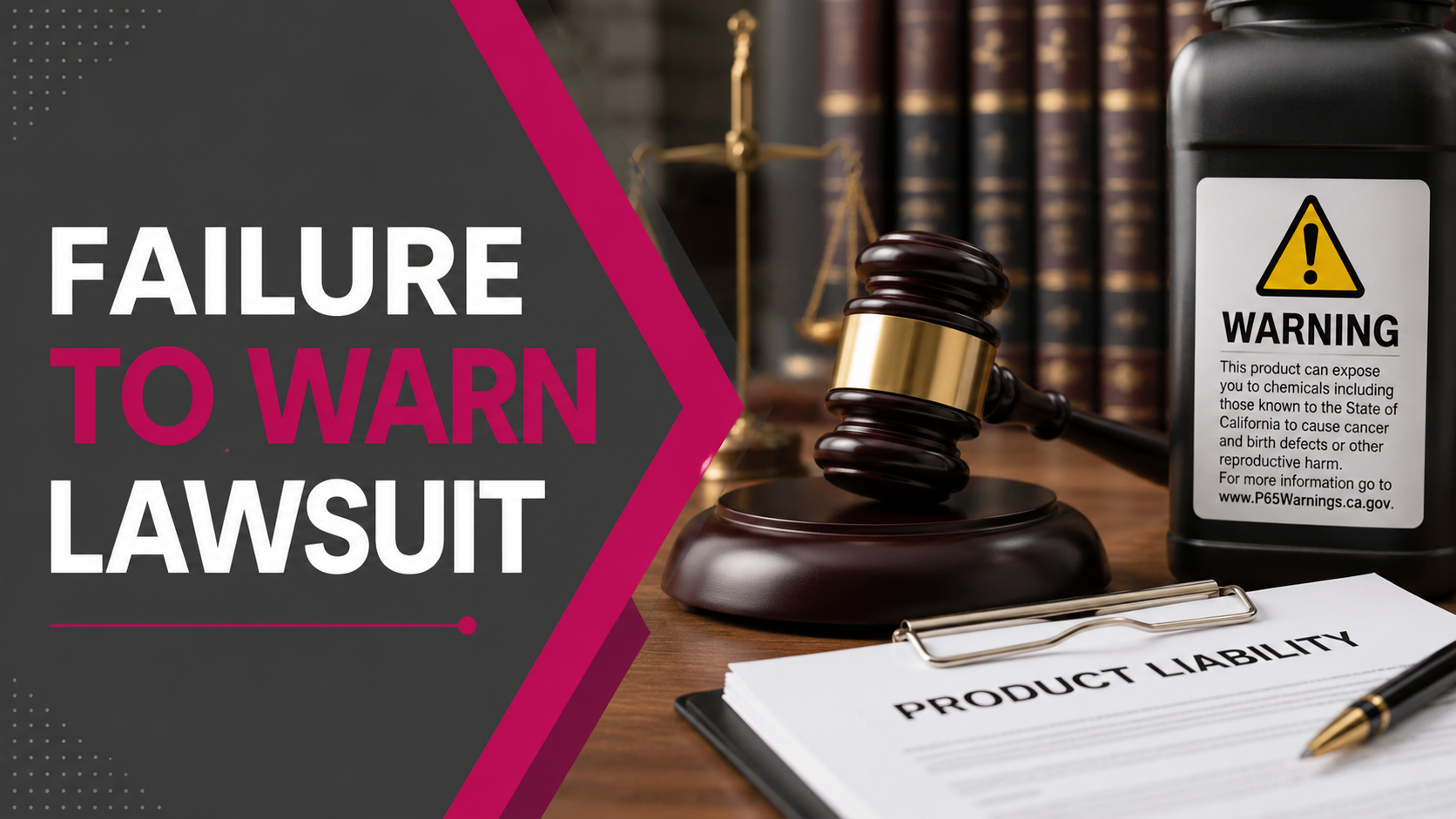
Every year, thousands of people suffer serious injuries from products they trusted. Sometimes the product itself works fine. The real problem sits in the fine print (or the complete lack of it). When a manufacturer fails to tell you about a known danger, and that silence leads to harm, you may have a failure to warn lawsuit on your hands.
This guide walks you through product liability claims based on inadequate warnings. You will learn what counts as a marketing defect, how to prove your case, common defenses companies raise, and the practical steps that protect your rights. Whether you faced side effects from a prescription drug, an injury from a consumer product with a missing warning, or harm from a dangerous product in the chain of distribution, this article gives you clear, actionable information.
What Is a Failure to Warn Lawsuit?
A failure to warn lawsuit is a type of product liability claim. It focuses on the information (or lack of information) that came with a product. Manufacturers and sellers have a duty to warn users about non-obvious risks that can cause harm during normal or foreseeable use.
Courts treat inadequate warnings as a marketing defect. The product may be designed and built correctly, yet still be defective because the company did not provide clear, adequate instructions or alerts about a foreseeable risk of harm.
Think of it this way: a power tool can be perfectly engineered. If the instruction manual never mentions the risk of kickback under certain conditions, and that kickback injures you, the missing warning becomes the defect. The same principle applies to medications that omit serious side effects, chemicals that lack proper handling instructions, or household products that hide known dangers.
These claims can proceed under strict liability, negligence, or both, depending on the state. Under strict liability, you usually do not need to prove the company was careless. You show the product reached you without adequate warnings and that the missing information caused your injury.
The Three Types of Product Defects
Product liability law generally recognizes three categories of defects:
- Manufacturing defects: A mistake during production makes one item different from (and more dangerous than) the intended design.
- Design defects: The entire product line is unreasonably dangerous because of how it was engineered.
- Marketing defects (also called warning defects): The product lacks proper instructions or warnings about risks.
Failure to warn falls squarely in the third category. A product can be free of manufacturing and design flaws yet still support a strong product liability claim if the warnings fall short.
Courts look at whether the risk was known or knowable at the time of sale, whether ordinary users would recognize the danger without help, and whether better warnings could have reduced or avoided the harm.
Elements of a Failure to Warn Claim
To succeed in a failure to warn lawsuit, you generally must prove several core elements. Exact wording varies by state, but most jurisdictions require proof of the following:
- The defendant manufactured, distributed, or sold the product.
- The product carried potential risks that were known or knowable given the scientific and medical knowledge available at the time.
- Those risks presented a substantial danger when the product was used or misused in an intended or reasonably foreseeable way.
- Ordinary consumers would not have recognized the risks on their own.
- The defendant failed to provide adequate warnings or instructions.
- The lack of adequate warnings caused your injury.
Causation often involves a “heeding presumption.” Many courts presume that a plaintiff would have followed a proper warning if one had been given. The defendant can try to rebut that presumption with evidence that you would have ignored even a clear warning.
Expert testimony frequently plays a key role. Experts may explain industry standards for warnings, the state of scientific knowledge at the relevant time, and how an adequate warning would have changed user behavior.
Who Can Be Held Liable? The Chain of Distribution
Liability is not limited to the company that designed the product. Anyone in the chain of distribution can face claims in many states. This includes:
- Manufacturers
- Component part suppliers
- Distributors and wholesalers
- Retailers
Strict liability often applies to all commercial sellers who placed the product in the stream of commerce. Some states limit retailer liability unless the retailer knew of the defect, altered the product, or failed to pass along the manufacturer’s warnings.
The learned intermediary doctrine creates an important exception for prescription drugs and medical devices. In those cases, the manufacturer’s duty is usually to warn the prescribing physician, not the patient directly. The doctor then decides what information to share with the patient. If the manufacturer adequately warned the doctor, the claim against the company may fail even if the patient never received the information.
Real-World Examples of Failure to Warn Cases
Failure to warn claims appear across many product categories.
Pharmaceutical cases are common. Patients have sued over blood thinners that allegedly failed to warn adequately about bleeding risks, antidepressants linked to suicide risk in certain age groups, and other medications whose labels omitted or downplayed serious side effects. In one notable case involving a blood thinner, a jury awarded substantial compensatory and punitive damages after finding the warnings inadequate.
Consumer products also generate claims. Power tools, recreational equipment, household chemicals, and children’s products have all faced lawsuits when warnings failed to address specific hazards or foreseeable misuse. Courts have held that warnings must address both intended use and reasonably foreseeable misuse.
These examples show that a successful claim does not require the product to be “broken.” The missing or unclear information itself can create liability when it leads to preventable harm.
How to Prove a Failure to Warn Product Liability Case
Building a strong case starts with evidence. Key pieces often include:
- The product itself and its original packaging or labeling
- Medical records documenting the injury and treatment
- Photographs of the product and the scene of the injury
- Expert analysis of the warnings’ adequacy
- Internal company documents showing knowledge of the risk
- Industry standards or competing products that carried better warnings
- Testimony about how you used the product and whether a proper warning would have changed your actions
Your attorney will investigate whether the risk was known or knowable. Discovery often uncovers adverse event reports, internal studies, or communications that show the company understood the danger yet failed to update its labels.
Causation requires connecting the inadequate warning to the injury. Courts examine whether a reasonable person, properly warned, would have avoided the risk. In pharmaceutical cases, the focus frequently shifts to whether a different warning would have changed the physician’s prescribing decision.
Common Defenses in Failure to Warn Lawsuits
Manufacturers and sellers raise several recurring defenses:
- Obvious danger: The risk was so apparent that no warning was needed (a knife is sharp; a hot stove burns).
- Adequate warning: The company claims the existing warning was clear, prominent, and sufficient.
- Unforeseeable misuse: The product was used in a way the manufacturer could not reasonably anticipate.
- Sophisticated user: The plaintiff (or an intermediary) possessed specialized knowledge that made a warning unnecessary.
- State of the art: The risk was not knowable given the scientific knowledge available when the product was sold.
- Learned intermediary: In drug and device cases, the company adequately warned the prescribing doctor.
- Assumption of risk or comparative fault: The plaintiff knew of the danger and proceeded anyway, or contributed to the injury through their own actions.
Some states also recognize a post-sale duty to warn when new risks become known after the product enters the market. Failure to issue updated warnings or recalls can support additional claims.
Statute of Limitations for Failure to Warn Claims
Time limits vary significantly by state. Many jurisdictions give plaintiffs two to three years from the date of injury to file a personal injury or product liability lawsuit. Some states use a discovery rule: the clock starts when you discovered (or reasonably should have discovered) both the injury and its connection to the product.
Statutes of repose in certain states set an absolute outer limit measured from the date of sale or manufacture, regardless of when the injury appeared. Missing these deadlines usually bars the claim permanently.
Because the rules differ and exceptions exist (fraudulent concealment, continuing exposure, minority status), consult a product liability attorney promptly after an injury. Waiting can destroy your ability to recover.
Damages Available in a Failure to Warn Lawsuit
Successful plaintiffs may recover compensatory damages that cover:
- Past and future medical expenses
- Lost wages and diminished earning capacity
- Pain and suffering
- Emotional distress
- Loss of enjoyment of life
- Permanent disability or disfigurement
In cases involving egregious conduct (willful disregard of known risks, concealment of safety data), some states allow punitive damages designed to punish the defendant and deter similar behavior.
Wrongful death claims may also be available when inadequate warnings contribute to a fatal injury. Family members can seek compensation for loss of support, companionship, and funeral expenses.
Practical Steps After an Injury from a Dangerous Product
If you believe a missing or inadequate warning caused your injury, take these steps quickly:
- Seek medical attention and follow all treatment recommendations. Document everything.
- Preserve the product, packaging, instructions, and any remaining warnings. Do not alter or discard them.
- Photograph the product, the injury, and the scene.
- Write down exactly how you used the product and what warnings (if any) you saw.
- Avoid giving recorded statements to insurance companies or the manufacturer without legal advice.
- Contact a personal injury attorney experienced in product liability claims for a free case evaluation.
An attorney can investigate the product’s history, consult experts, identify all potentially liable parties in the chain of distribution, and protect you from aggressive defense tactics.
Pitfalls That Can Weaken Your Claim
Several common mistakes hurt otherwise strong cases:
- Discarding or altering the product before an expert can examine it
- Waiting too long and missing the statute of limitations
- Posting details about the incident on social media
- Accepting a quick settlement offer without understanding the full value of your claim
- Failing to document ongoing medical treatment and expenses
Acting early and carefully preserves the strongest possible case.
Conclusion
A failure to warn lawsuit gives injured consumers a path to accountability when companies fail to provide the information people need to stay safe. By understanding marketing defects, the duty to warn, the elements of proof, available defenses, and the time limits that apply, you put yourself in a stronger position to protect your rights.
If a dangerous product with inadequate warnings caused your injury, you do not have to navigate the process alone. Speak with a qualified personal injury or product liability attorney who can evaluate your claim, explain your options, and help you pursue the compensation you deserve. Early action often makes the difference between a successful recovery and a lost opportunity.
Frequently Asked Questions
What is the difference between a failure to warn claim and a design defect claim?
A design defect alleges the product is unreasonably dangerous because of how it was engineered. A failure to warn claim focuses on missing or inadequate information about risks. Both can exist in the same case.
Do I need to prove the manufacturer knew about the risk?
In most strict liability failure to warn cases, you must show the risk was known or knowable based on scientific knowledge available at the time. Negligence claims require proof the company failed to exercise reasonable care in providing warnings.
Can I sue if I misused the product?
Possibly. Manufacturers must warn about reasonably foreseeable misuse. Completely unforeseeable or extreme misuse may defeat the claim.
How long do failure to warn cases usually take?
Complex product liability cases often last one to three years or longer, especially if they involve extensive discovery, expert testimony, or multi-district litigation. Many settle before trial.
What role does the learned intermediary doctrine play?
In prescription drug and medical device cases, the manufacturer typically discharges its duty by warning the prescribing physician rather than the patient. If the doctor was adequately warned, the patient’s claim may fail on causation grounds.
Are warning labels required to be in languages other than English?
Generally no, though specific statutes or regulations (such as certain state consumer protection laws) may impose additional requirements in limited circumstances.
Can retailers be sued for failure to warn?
Yes, in many states under strict liability principles, although some jurisdictions limit retailer liability unless the retailer knew of the defect or failed to pass on manufacturer warnings.
You May Also Like: Defective Product Lawsuit: Understanding Your Rights