
 By Tort Law Team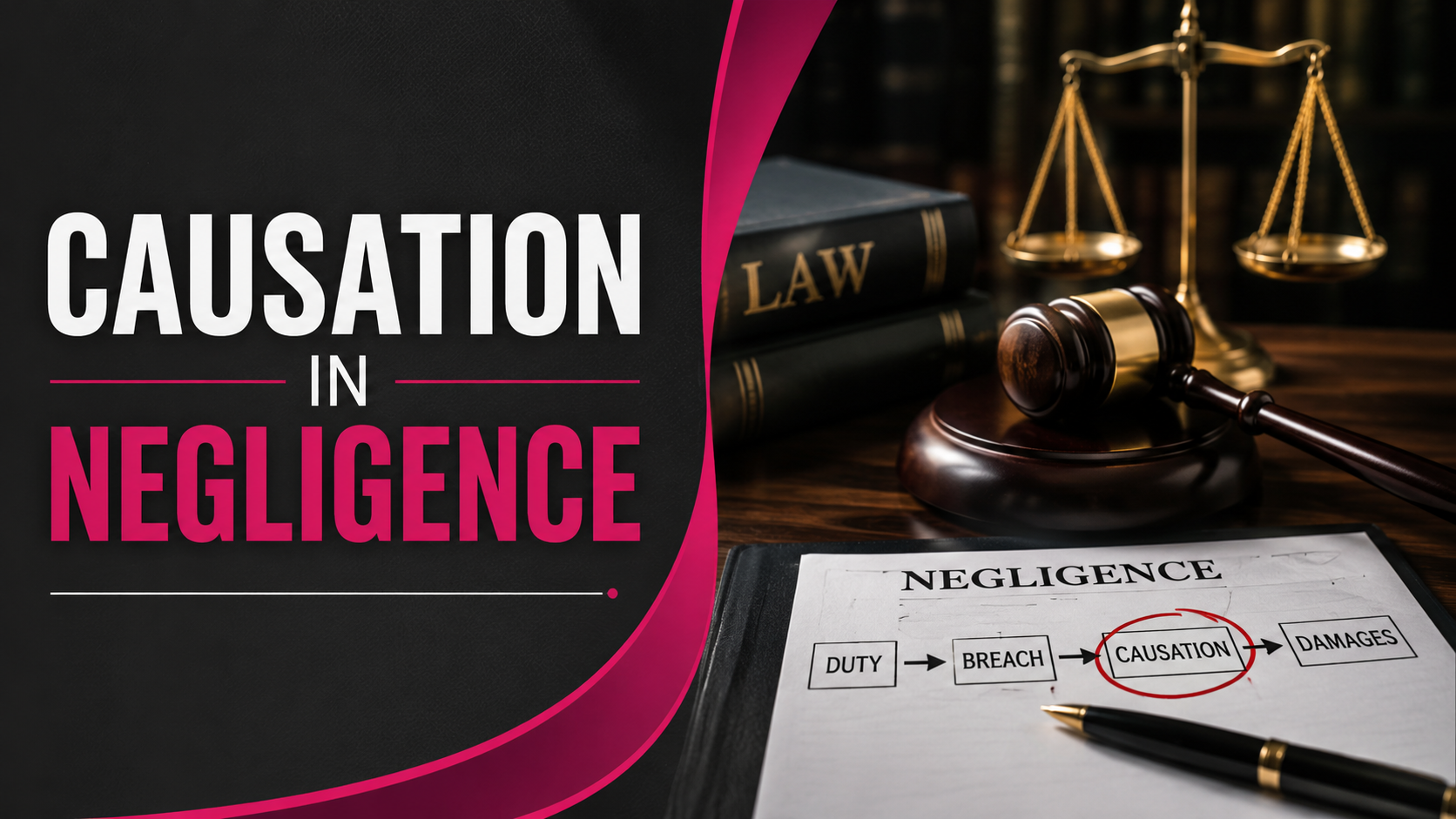
You slipped on a wet floor with no warning sign, broke your wrist, and now you’re staring at medical bills wondering if you have a case. Here’s the catch: proving someone was careless isn’t enough. You also have to prove their carelessness actually caused your injury. That’s where causation in negligence comes in, and it’s often the single most contested issue in a personal injury claim.
This guide breaks down how courts determine causation, from the but-for test to proximate cause and everything that can complicate the picture. Whether you’re evaluating your own potential claim, studying for a torts exam, or just curious how liability really works, you’ll walk away with a clear, practical understanding of one of tort law’s trickiest concepts.
What Is Causation in Negligence?
Every negligence claim rests on four pillars: duty of care, breach of duty, causation, and damages. You need all four to win. Miss one, and your case falls apart, no matter how careless the other party was.
Causation is the bridge between breach and harm. It’s not enough to show someone acted carelessly. You have to show that carelessness is what actually hurt you.
Think of it this way: your neighbor might leave their icy driveway unshoveled (a breach of duty), but if you never set foot on it, their negligence never causes you any harm. No connection, no claim.
Courts split causation into two distinct tests, and you need to satisfy both:
- Actual cause (also called “cause in fact”): Did the defendant’s conduct actually produce the injury?
- Proximate cause (also called “legal cause”): Is it fair to hold the defendant legally responsible for this particular outcome?
These aren’t interchangeable. A defendant’s actions can be the actual cause of your injury and still escape legal responsibility if the outcome was too remote or unforeseeable. That distinction trips up a lot of people, including some law students in their first semester.
Actual Cause: The But-For Test
Actual cause is usually the easier hurdle. Courts typically apply the but-for test: but for the defendant’s conduct, would the injury have occurred?
If the answer is no, meaning the injury wouldn’t have happened without the defendant’s actions, you’ve established actual cause.
How the But-For Test Works in Practice
Say a delivery driver runs a red light and T-bones your car. Ask yourself: but for the driver running the light, would you have been hit? No. The collision only happened because they blew through the intersection. Actual cause established.
Here’s a classic example law professors love: a doctor fails to properly diagnose a patient’s condition, and the patient later dies from that condition. But for the misdiagnosis, would the patient have survived? If earlier treatment would have saved them, the answer is yes, and the misdiagnosis is the actual cause.
When the But-For Test Falls Short
The but-for test breaks down in situations involving multiple sufficient causes. Imagine two separate fires, each independently large enough to burn down a house, merge into one blaze that destroys the structure. Under a strict but-for analysis, neither fire alone is a “necessary” cause since the house would have burned either way.
Courts recognized this gap and developed the substantial factor test as an alternative. Under this approach, a defendant’s conduct counts as actual cause if it was a substantial factor in bringing about the harm, even if it wasn’t strictly necessary on its own. Many jurisdictions apply the substantial factor test specifically in these multiple-sufficient-cause scenarios.
Proximate Cause: Where Foreseeability Comes In
Establishing actual cause only gets you halfway there. Even if the defendant’s conduct technically caused your injury, courts won’t hold them liable for consequences that are too far removed, unusual, or unpredictable. That’s what proximate cause (or legal cause) addresses.
The central question: was the harm a foreseeable result of the defendant’s negligence?
The Foreseeability Standard
Courts don’t expect defendants to anticipate every conceivable outcome of their actions. They only hold people responsible for harms a reasonable person could have predicted.
Picture a construction company that leaves a pile of loose bricks unsecured near a sidewalk. A pedestrian trips over the bricks and breaks an ankle. That’s a foreseeable consequence of leaving debris where people walk.
Now imagine instead that a bird picks up one of the bricks, drops it three blocks away, and it hits a parked car’s windshield. Technically, the unsecured bricks are still the actual cause. But holding the construction company liable for that freak windshield damage would stretch legal cause past its breaking point. It’s not something a reasonable person would foresee.
The Landmark Case: Palsgraf v. Long Island Railroad
No discussion of proximate cause is complete without Palsgraf v. Long Island Railroad Co. (1928), one of the most famous cases in American tort law.
Railroad employees helped a passenger board a moving train, causing him to drop a package of fireworks. The fireworks exploded, and the shockwave knocked over scales at the other end of the platform, injuring Helen Palsgraf.
The court ruled the railroad wasn’t liable. Judge Cardozo reasoned that the employees’ conduct, however careless toward the man with the package, created no foreseeable risk to Palsgraf standing far away. Duty and proximate cause, the court held, run to those within the reasonably foreseeable “zone of danger,” not to every person harmed by an unpredictable chain of events. This case remains a cornerstone for teaching how foreseeability limits liability.
Intervening and Superseding Causes
Causation gets murkier when something happens between the defendant’s negligence and your injury. These are called intervening causes, and whether they cut off liability depends on foreseeability.
Intervening Cause vs. Superseding Cause
- An intervening cause is a separate event that occurs after the defendant’s negligent act and contributes to the injury. If it’s foreseeable, the original defendant typically remains liable.
- A superseding cause is an intervening cause so unforeseeable and significant that it breaks the chain of causation entirely, shifting liability away from the original defendant.
Say a store fails to fix a broken step (breach of duty), a customer falls and breaks their leg, and paramedics rushing them to the hospital get into a car accident that worsens the injury. Courts generally treat the ambulance accident as a foreseeable intervening event since emergency transport is a predictable consequence of needing medical care. The store likely stays on the hook.
Now change the facts: after the fall, a bystander deliberately assaults the injured customer while they wait for help. That criminal act is far less predictable and could be deemed a superseding cause, potentially relieving the store of liability for the assault-related injuries (though not for the original fall).
Why This Matters for Your Claim
If you’re evaluating a personal injury claim, ask whether anything happened between the initial negligence and your final injury. An insurance company will absolutely raise superseding cause arguments if there’s any gap in the chain, so understanding this concept helps you anticipate their defense strategy.
Special Causation Rules Worth Knowing
The Eggshell Skull Rule
One rule that surprises a lot of people: defendants must take their victims as they find them. If you have a preexisting condition that makes an injury far worse than it would be for an average person, the defendant is still liable for the full extent of the harm, even if they couldn’t have predicted your vulnerability.
This is called the eggshell skull rule (sometimes “thin skull rule”). If a minor fender bender fractures your spine because of an underlying bone condition, the at-fault driver doesn’t get a discount just because a healthier person would have walked away unhurt.
Multiple Defendants and Shared Causation
Injuries don’t always trace back to a single wrongdoer. When multiple parties contribute to your harm, courts apply various frameworks (joint and several liability, comparative fault, or contribution rules depending on the jurisdiction) to divide responsibility. This is common in car pileups, medical malpractice involving several providers, and product liability cases with multiple manufacturers in the supply chain.
How to Prove Causation in Your Personal Injury Case
If you’re building a personal injury claim, here’s a practical breakdown of what establishing causation actually looks like:
- Document the timeline. Establish exactly what happened, in what order, from the defendant’s negligent act to your injury.
- Gather medical evidence. Medical records connecting your injury directly to the incident are often the backbone of actual cause.
- Identify any gaps in the chain. Look for intervening events and be ready to explain why they were foreseeable, not superseding.
- Consult expert witnesses when needed. Medical experts, accident reconstructionists, and industry specialists frequently testify to strengthen causation arguments in complex cases.
- Anticipate the defense. Insurance companies and defense attorneys will look for any weak link in your causation chain, so it helps to know their likely arguments in advance.
Causation disputes are exactly why so many personal injury cases hinge on skilled legal representation. Attorneys who handle these claims regularly know how to build a causation narrative that holds up, and they know which precedents and expert testimony carry weight with judges and juries.
Common Pitfalls to Avoid
- Assuming breach alone proves your case. Careless conduct without a proven causal link to your injury won’t succeed in court.
- Ignoring foreseeability. Even with clear actual cause, unforeseeable consequences may fall outside the defendant’s legal responsibility.
- Overlooking intervening events. Failing to address gaps in the causal chain leaves your claim vulnerable to superseding cause defenses.
- Underestimating the eggshell skull rule. Don’t assume a preexisting condition weakens your claim. It generally doesn’t reduce the defendant’s liability.
- Waiting too long to gather evidence. Causation often depends on evidence (surveillance footage, witness statements, medical documentation) that can disappear quickly.
Final Thoughts
Causation is where a lot of negligence claims are won or lost. Understanding both actual cause and proximate cause gives you a realistic picture of what you’d need to prove and where the challenges might arise.
If you believe you have a personal injury claim, the causation analysis is rarely something to navigate alone. A qualified personal injury attorney can evaluate the specific facts of your case, anticipate defense arguments, and help you build the strongest possible causal connection between what happened to you and who’s responsible.
Frequently Asked Questions
What’s the difference between actual cause and proximate cause?
Actual cause (or cause in fact) asks whether the defendant’s conduct literally produced the injury, usually tested with the but-for test. Proximate cause (legal cause) asks whether it’s fair to hold the defendant responsible, based on whether the harm was a foreseeable result of their conduct.
What is the but-for test in tort law?
The but-for test asks: but for the defendant’s negligent act, would the injury have occurred? If the injury wouldn’t have happened without the defendant’s conduct, actual cause is established.
What is a superseding cause in negligence cases?
A superseding cause is an unforeseeable, significant intervening event that breaks the causal chain between the defendant’s negligence and the plaintiff’s injury, potentially relieving the defendant of liability for harm caused after that event.
Can I still win my case if there’s a gap between the negligent act and my injury?
Possibly. If the intervening event was reasonably foreseeable, the original defendant typically remains liable. If it was highly unforeseeable and independent, it may be treated as a superseding cause that limits their liability.
What is the eggshell skull rule?
It’s a legal principle holding that defendants are liable for the full extent of a plaintiff’s injuries, even if a preexisting condition made those injuries more severe than they’d be for an average person.
Do I need a lawyer to prove causation in my case?
You’re not legally required to have one, but causation disputes are often the most technical and contested part of a negligence claim. An experienced personal injury attorney can identify weaknesses in your causation argument and counter defense strategies effectively.
What are the four elements of a negligence claim?
Duty of care, breach of duty, causation (actual and proximate), and damages. All four must be proven for a negligence claim to succeed.
You May Also Like: Breach of Duty Examples: How to Spot Negligence