
 By Tort Law Team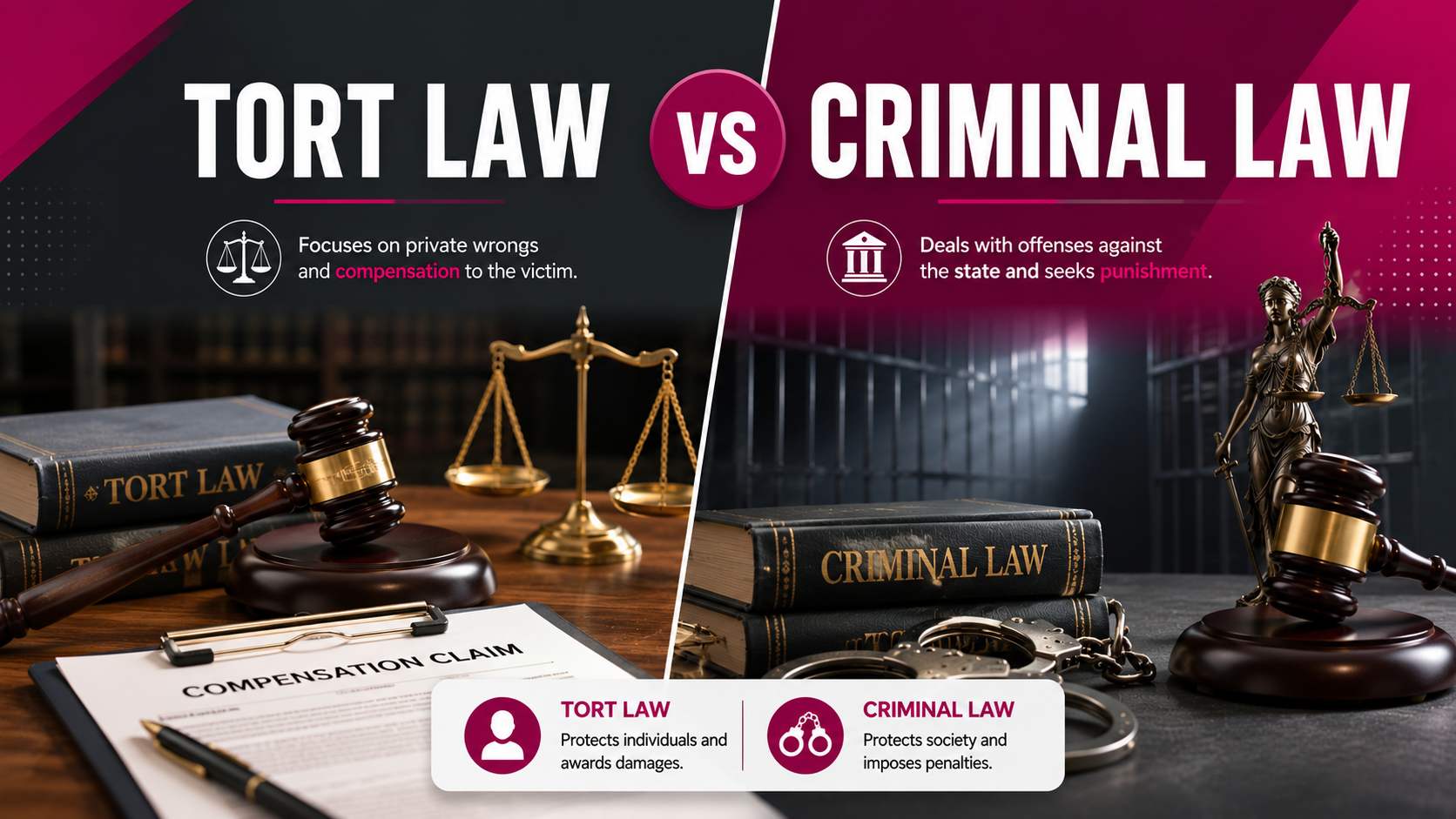
Imagine you are rear-ended by a distracted driver who caused serious injuries and vehicle damage. The police might investigate, and the state could file criminal charges for reckless driving. Separately, you could sue the driver for your medical bills, lost wages, and pain. These are two distinct legal paths: one under tort law and one under criminal law.
This article breaks down tort law vs criminal law so you can understand your rights whether you face an injury, property damage, or a dispute. Law students and professionals will find clear comparisons of standards and procedures. Business owners and everyday people will learn practical steps to seek justice or compensation. You will see how the same incident can trigger both systems and what that means for outcomes.
What Is Tort Law?
Tort law is a branch of civil law that addresses private wrongs, or civil wrongs, where one person’s actions harm another person or their property. The goal is to compensate the victim (the plaintiff) rather than punish the wrongdoer.
Torts fall into three main categories:
- Intentional torts: Deliberate acts like assault, battery, false imprisonment, or defamation.
- Negligence: The most common type, involving failure to exercise reasonable care (for example, a doctor making a preventable mistake or a driver texting behind the wheel).
- Strict liability: Responsibility without proving fault, often seen in defective product cases or keeping dangerous animals.
In a tort case, the plaintiff initiates civil litigation by filing a lawsuit. The focus stays on making the injured party “whole” again through monetary damages.
What Is Criminal Law?
Criminal law, part of public law, deals with offenses against society as a whole. The state or government (through a prosecutor) brings charges against the accused to punish wrongdoing, deter future crimes, and protect the public.
Crimes require mens rea (guilty mind) in most cases, meaning the defendant acted with intent, knowledge, or recklessness. Outcomes include fines, probation, imprisonment, or other punitive measures.
Unlike tort cases, victims do not control criminal prosecutions. The state decides whether to pursue charges.
Key Differences Between Tort Law and Criminal Law
Understanding tort law vs criminal law helps you identify the right path after an incident. Here is a clear breakdown.
Parties Involved
- Tort law: Plaintiff (victim) versus defendant (wrongdoer). The injured person drives the case.
- Criminal law: State (prosecutor) versus defendant. The government represents society.
Purpose and Goals
Tort law seeks restitution and compensation for losses like medical costs, lost income, and emotional distress. Criminal law focuses on punishment, rehabilitation, and public safety.
Standard of Proof
This is one of the most important distinctions.
- In tort law (civil cases), the burden is “preponderance of the evidence,” also called balance of probabilities. The plaintiff must show it is more likely than not (over 50% chance) that the defendant caused the harm.
- In criminal law, the prosecutor must prove guilt “beyond a reasonable doubt,” a much higher bar (often described as near certainty). This protects individual liberty.
This difference explains why someone acquitted in criminal court can still face liability in a civil tort suit.
Remedies and Outcomes
- Tort law: Primarily monetary damages (compensatory, which can include economic and non-economic losses, and sometimes punitive damages to deter egregious behavior). Other remedies include injunctions.
- Criminal law: Fines paid to the state, restitution to victims (in some cases), jail or prison time, probation, or community service. No direct compensation lawsuit is needed, though victims may receive restitution orders.
Who Brings the Action?
In torts, you (or your attorney) file the claim. In crimes, you report to police, but the prosecutor decides on charges.
Examples of Tort Law vs Criminal Law
Real-world scenarios illustrate the differences.
Car Accident Example: A driver runs a red light and hits your car.
- Criminal: The state might charge reckless driving or DUI if alcohol was involved.
- Tort: You sue for personal injury damages covering repairs, medical treatment, and lost wages.
Assault and Battery: Someone punches you in a bar fight.
- Criminal: The state prosecutes for assault.
- Tort: You file a civil suit for medical bills and pain and suffering.
Theft: A neighbor steals your tools.
- Criminal: Prosecution for theft.
- Tort: Civil action for conversion or trespass to chattels to recover the value.
These examples of tort law vs criminal law show how the systems address the same harm differently.
Can an Act Be Both a Tort and a Crime?
Yes. Many actions qualify as both. The O.J. Simpson case is a famous example: acquitted in criminal court for murder but found liable in a civil wrongful death suit. The lower civil standard of proof made the difference.
Other common overlaps include:
- Battery/assault
- Drunk driving causing injury
- Fraud
- Property damage
- Wrongful death/homicide
Victims can pursue both paths independently. A criminal conviction can strengthen a civil case through issue preclusion in many jurisdictions.
Standard of Proof in Tort Law vs Criminal Law
The burden of proof in civil vs criminal cases is a frequent point of confusion.
“Balance of probabilities” in torts allows recovery even with some uncertainty, as long as the scales tip in the plaintiff’s favor. “Beyond a reasonable doubt” demands near-certainty because the consequences (loss of freedom) are severe.
This lower threshold in civil cases explains why civil suits often succeed where criminal prosecutions do not.
Step-by-Step: How to Pursue a Tort Claim
- Document everything: Gather evidence, medical records, photos, and witness statements.
- Seek medical attention: This establishes damages.
- Consult an attorney: Many personal injury lawyers work on contingency.
- File the claim: Often starts with a demand letter to the at-fault party’s insurer.
- Negotiate or litigate: Most cases settle; others go to trial.
Statutes of limitations apply (often 1-3 years for personal injury), so act promptly.
For criminal matters, report to police immediately. The prosecutor handles the rest, though victim impact statements can influence sentencing.
Pitfalls to Avoid
- Assuming a criminal conviction guarantees civil victory (though it helps).
- Delaying action and missing deadlines.
- Handling complex cases without legal help, especially against corporations or insurers.
- Confusing the systems: You cannot “press charges” in a pure tort matter.
Business owners should carry adequate insurance to cover potential tort liabilities.
Recent Developments and Precedents
Laws evolve. Courts continue to refine negligence standards, especially in areas like autonomous vehicles, data privacy torts, and medical malpractice. High-profile cases often highlight overlaps, reminding the public that justice can come through multiple avenues.
For authoritative sources, review materials from Cornell Law School’s Legal Information Institute or your state’s bar association resources.
Practical Advice for Victims and Professionals
If you sustained an injury or property damage, ask: Does this affect me privately (tort) or society broadly (crime)? Often, both apply. Consult a qualified attorney early to evaluate options. Law students should study landmark cases like Palsgraf v. Long Island Railroad for duty and foreseeability in negligence.
Business owners: Implement strong safety protocols to minimize tort exposure. Everyday individuals: Know your rights. Reporting crimes helps the community, while pursuing tort remedies restores your losses.
Conclusion
Tort law vs criminal law represent two vital but separate tracks in the justice system. One restores victims through compensation under a lower standard of proof. The other punishes and deters through the power of the state. Recognizing when your situation involves civil wrongs, public law, or both empowers you to take appropriate action.
Understanding these differences clarifies your legal rights and options. Do not navigate complex disputes alone. Consult a licensed attorney to evaluate your specific case and explore the best path forward.
Frequently Asked Questions
What is the difference between a tort and a crime?
A tort is a private civil wrong remedied by compensation. A crime is a public offense prosecuted by the state for punishment.
Can the same act lead to both civil and criminal consequences?
Yes. Assault, drunk driving causing injury, and many others can result in both a tort lawsuit and criminal charges.
What is the standard of proof in tort law vs criminal law?
Tort (civil): preponderance of the evidence (more likely than not).
Criminal: beyond a reasonable doubt.
Do I need a lawyer for a tort claim?
It is highly recommended, especially for significant damages. Many work on contingency, meaning no upfront fees.
What remedies are available in tort law?
Primarily monetary damages for economic losses, pain and suffering, and sometimes punitive damages. Injunctions may also apply.
How does burden of proof in civil vs criminal cases affect outcomes?
The lower civil standard allows victims to recover compensation even if criminal charges fail or are not filed.
Should I report an incident to police even if I plan a civil suit?
Yes. It creates an official record that can support your tort claim and serves the public interest.
You May Also Like: Tort Law Legal Guide: Understanding Civil Liability