
 By Tort Law Team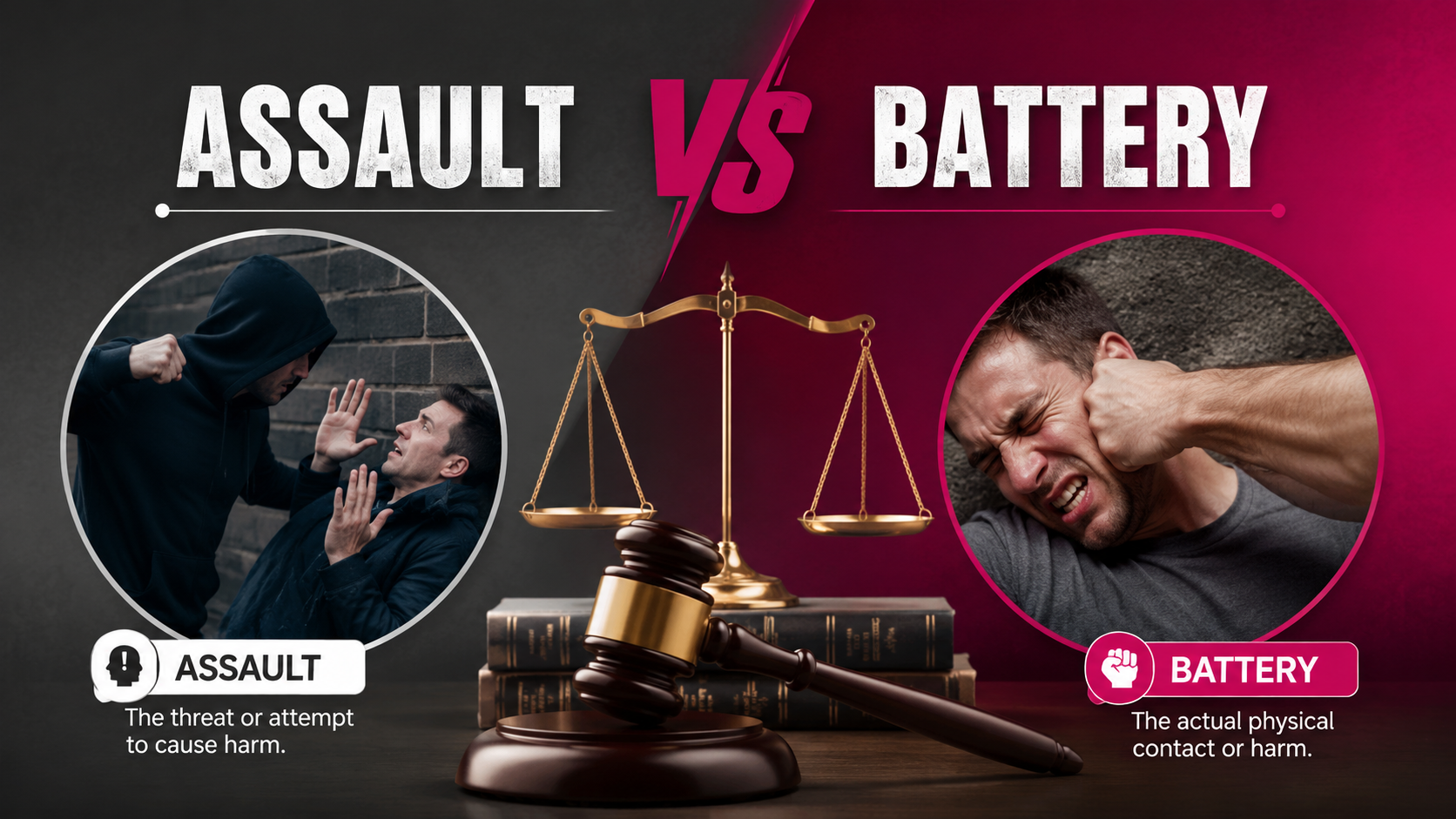
Imagine this: someone raises a fist and lunges toward you in an argument. You freeze, heart racing, certain a punch is coming. Then they stop short. Did a crime happen? What if they actually make contact? Everyday people face these moments in heated disputes, bar fights, or even workplace confrontations. Yet the terms “assault” and “battery” get mixed up constantly in news reports, TV shows, and casual talk.
This guide clears up the confusion around assault vs battery. You’ll learn the precise legal definitions in both criminal and civil contexts, how claims work, what penalties look like, and practical steps if you ever face these issues. Whether you’re dealing with a minor dispute, studying law basics, or just want solid information, the distinctions matter for your rights and potential consequences.
What Is Assault in the Eyes of the Law?
Assault centers on fear and anticipation, not actual contact. In most U.S. jurisdictions, it is an intentional act that causes another person to feel a reasonable apprehension of imminent harmful or offensive physical contact.
Think of it as the threat or attempt. The person must have the apparent ability to follow through right away. Words alone rarely qualify unless paired with actions that make the threat feel immediate. The victim needs to be aware of the threat. If someone swings at you from behind and you never notice, that usually fails the assault test.
Key elements typically include:
- Intent to cause apprehension or to commit a battery
- An act that creates a reasonable fear of imminent contact
- The apparent present ability to carry out the threat
States define it slightly differently. Some treat assault as an attempted battery. Others focus purely on the fear created. In civil law, assault is an intentional tort. In criminal law, it becomes a charge prosecutors can bring.
A classic example: During a heated argument, one person steps forward, raises a clenched fist, and says, “I’m going to knock you out.” If the other person reasonably believes a punch is about to land, that can count as assault even if no one ever touches anyone.
What Is Battery?
Battery requires actual physical contact. It is the intentional harmful or offensive touching of another person without consent.
The contact does not need to cause serious injury. Spitting, a light shove, or even unwanted touching of clothing can qualify if it offends a reasonable sense of personal dignity. The intent focuses on the contact itself. You do not always need to intend specific harm, just the unwanted touch.
Core elements usually are:
- Intentional act
- Harmful or offensive contact
- Lack of consent from the victim
- Causation linking the act to the contact
Battery often follows an assault in the same incident. Someone threatens, then follows through. But battery can stand alone. A surprise hit from behind, where the victim never saw it coming, is pure battery with no preceding assault.
In both civil and criminal systems, battery protects bodily integrity. Civil cases treat it as an intentional tort that can lead to a personal injury lawsuit. Criminal cases treat it as a public offense punishable by the state.
The Core Difference Between Assault and Battery
The simplest way to remember the difference between assault and battery is this: assault is about the threat and the fear it creates. Battery is about the completed contact.
You can have assault without battery. Someone lunges and misses, or stops short after creating real fear. You can also have battery without assault. Contact happens without any prior warning the victim perceived.
Many states still charge them together or use the combined phrase “assault and battery.” A few, like Texas in some contexts, fold the concepts into a single assault statute that covers both threats and contact. Always check the specific state law that applies to your situation.
This distinction affects charging decisions, available defenses, and potential outcomes in both criminal charges and civil claims.
Can You Have Assault Without Battery?
Yes. Courts regularly recognize pure assault cases. The law protects people from the mental and emotional harm of imminent threats, not only from bruises.
Real-world examples include:
- Raising a weapon or fist in a threatening way without striking
- Throwing an object that misses but creates fear of being hit
- Advancing aggressively while making clear the contact is about to happen
The apprehension must be reasonable and of imminent harm. A threat to “get you next week” usually does not qualify because the danger is not immediate.
This possibility answers a frequent question: can you have assault without battery? Absolutely, and prosecutors or civil plaintiffs can pursue it on its own.
Civil Assault vs Battery vs Criminal Versions
The same facts can trigger both systems at once. They serve different purposes and follow different rules.
Criminal Charges
The government brings the case. A prosecutor decides whether to charge. The goal is punishment and public safety. The burden of proof is high: beyond a reasonable doubt.
Possible outcomes include fines, probation, community service, jail or prison time, and a permanent criminal record. Degrees matter. Simple assault or battery is often a misdemeanor. Aggravated versions involving weapons, serious injury, or protected victims (police, children, elderly) become felonies.
Civil Liability and Personal Injury Lawsuits
The victim files the case as a private personal injury lawsuit. The goal is compensation for medical bills, lost wages, pain and suffering, and sometimes punitive damages. The burden is lower: preponderance of the evidence (more likely than not).
Civil assault and battery are classic intentional torts. Success can produce money damages even if a criminal case ends in acquittal or never gets filed. Double jeopardy does not block the civil path.
Understanding civil vs criminal assault and battery helps victims decide whether to press charges, pursue a lawsuit, or both. It also helps defendants prepare different strategies for each forum.
Key Elements That Must Be Proven
For Assault
Plaintiffs or prosecutors generally need to show:
- An intentional act by the defendant
- That caused the victim to reasonably apprehend imminent harmful or offensive contact
- The defendant had the apparent ability to complete the contact
Awareness by the victim is usually required. Hidden threats the person never notices rarely succeed.
For Battery
The proof typically requires:
- Intentional contact
- That was harmful or offensive
- Without the victim’s consent
- Causing the contact to occur
Consent is a powerful issue. Contact in sports, medical treatment, or mutual combat may be privileged if within expected bounds.
Transferred intent can apply. If you aim at one person and hit another, the intent often transfers.
Common Examples of Assault and Battery
Everyday situations clarify the lines:
- Bar argument: Person A shoves Person B after yelling threats. Both assault (the threat and lunge) and battery (the shove) occur.
- Road rage: Driver gets out, approaches another car with fists raised, then punches through the open window. Full sequence of both.
- Workplace dispute: Supervisor raises a hand as if to strike but never touches. Potential pure assault.
- Surprise incident: Someone is struck from behind while walking. Battery without prior assault.
- Spitting or unwanted grabbing: Often pure battery if no prior threat was perceived.
These common examples of assault and battery show why context, intent, and the victim’s experience all matter.
Penalties for Assault and Battery
Penalties vary widely by state, the degree of the offense, prior record, and specific facts. Always consult local statutes.
Simple (Misdemeanor) Level
Typically involves minor or no injury and no weapon. Possible results:
- Jail up to six months or one year
- Fines from a few hundred to several thousand dollars
- Probation, anger management classes, restitution
Aggravated (Felony) Level
Factors that elevate the charge include use of a deadly weapon, serious bodily injury, targeting protected persons, or intent to commit another felony. Penalties can include:
- Prison terms of several years up to decades
- Higher fines
- Loss of firearm rights
- Longer probation or parole
Federal law covers certain assaults on federal property or involving federal officers, with its own sentencing structure. Some states use numbered degrees (first-degree most serious). Others stick to simple versus aggravated labels.
Civil consequences sit alongside any criminal sentence. A damages award can reach tens or hundreds of thousands of dollars depending on injuries and evidence.
Common Legal Defenses
Defendants are not without options. Strong defenses include:
- Self-defense: Reasonable belief of imminent harm and proportional force used. Many states no longer require retreat in certain situations.
- Defense of others: Similar standards when protecting someone else.
- Consent: The contact was agreed to, such as in contact sports.
- Lack of intent: The act was accidental or the defendant lacked the required mental state.
- No reasonable apprehension: For assault claims, the victim’s fear was not reasonable or the threat was not imminent.
- False accusation or mistaken identity: Evidence shows the events did not occur as claimed.
An experienced attorney evaluates which defenses fit the facts and evidence. Early investigation of witnesses, video, and medical records often proves decisive.
How to Respond If You Are Involved
If You Are a Victim
Document everything. Seek medical care even for minor injuries. Report to police if criminal charges seem appropriate. Preserve evidence such as photos, texts, or clothing. Speak with a personal injury lawyer about civil options. Statutes of limitations apply, so act promptly.
For guidance on related civil processes, see our overview of how personal injury claims work.
If You Face Charges or a Lawsuit
Do not discuss details with police without counsel. Gather your own evidence and witnesses. Consult a criminal defense attorney quickly. Separate counsel may handle any parallel civil case.
Understanding available legal defenses early improves outcomes. For more on building a defense strategy, review common approaches in criminal cases.
Pitfalls to Avoid
People often make these mistakes:
- Assuming no injury means no case (contact or fear can still support claims)
- Waiting too long to report or seek advice
- Posting about the incident on social media
- Ignoring the civil track after a criminal case resolves
- Relying on informal “settlements” without proper releases
Laws change and vary. What works in one state may fail in another. Professional advice tailored to your jurisdiction remains essential.
Recent Trends and Practical Insights
Courts continue to refine what counts as “offensive” contact in an era of heightened awareness around personal space and consent. Domestic and workplace incidents receive closer scrutiny. Body-camera and smartphone video have transformed evidence in many cases, making contemporaneous recordings powerful for both sides.
One anonymized pattern seen by attorneys: heated verbal arguments that escalate into raised hands or short lunges frequently produce assault charges even when no one is hit. Prosecutors treat the creation of fear seriously when the threat feels immediate and credible.
Frequently Asked Questions
What is the main difference between assault and battery?
Assault involves creating reasonable fear of imminent harmful contact. Battery involves the actual unwanted contact. They often occur together but remain legally distinct in most places.
Can you be charged with assault if there was no physical contact?
Yes. Pure assault focuses on the apprehension of harm. Contact is not required.
Is assault always a crime?
It can be both a crime and a civil tort. The same facts may support criminal charges by the state and a private lawsuit for damages.
What are typical penalties for simple assault or battery?
Misdemeanor penalties often include up to one year in jail, fines, probation, and classes. Exact ranges depend on the state and circumstances.
Does self-defense work as a legal defense?
Yes, when the force used was reasonable and the person reasonably believed they faced imminent harm. Details of the encounter matter greatly.
Can battery occur without any injury?
Yes. Offensive contact that violates personal dignity can support a battery claim or charge even without visible harm.
How long do I have to file a civil claim?
Statutes of limitations vary by state, often one to three years for intentional torts. Check local rules promptly.
Key Takeaways and Next Steps
Assault focuses on the creation of reasonable fear of imminent contact. Battery requires the contact itself. Both can produce criminal charges and civil liability for bodily injury or emotional harm. Intent, consent, and the victim’s perception drive outcomes. Penalties range from modest misdemeanor consequences to serious felony sentences depending on aggravating factors.
If these issues touch your life, gather facts carefully and speak with a qualified attorney who knows your state’s rules. Early, informed action protects your rights whether you are seeking compensation, defending against claims, or simply clarifying what happened.
For related reading on intentional torts and personal injury options, explore our guide to civil claims after violence. External resources such as state court self-help pages or the Cornell Law School Legal Information Institute offer free statutory text for further study.