
 By Tort Law Team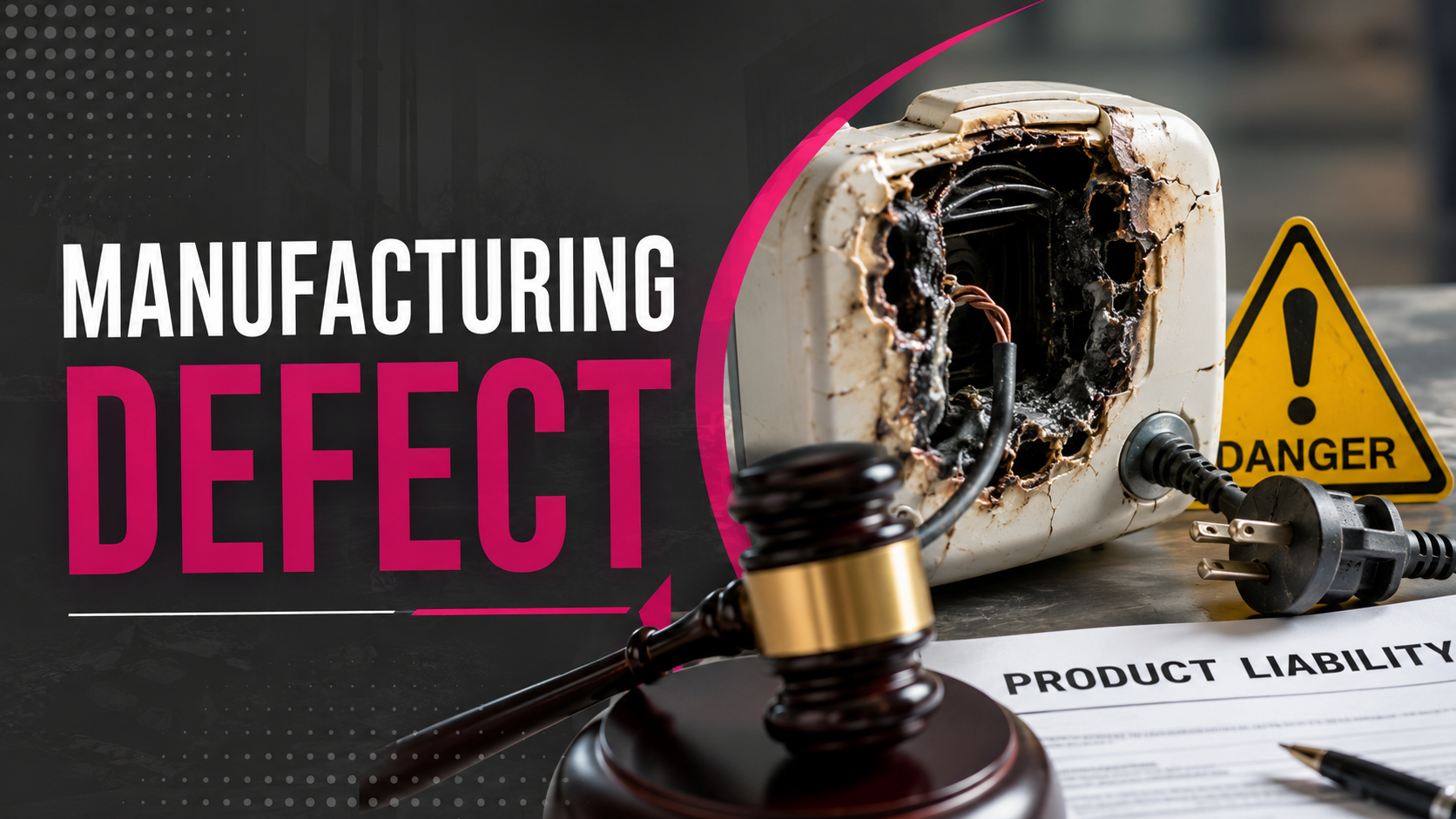
A single faulty weld, a misaligned component, or contaminated material can turn a carefully designed product into a liability nightmare. Industry data shows that the cost of poor quality often consumes 15 to 20 percent of a manufacturer’s annual sales revenue. For quality assurance managers, operations leaders, product designers, and business owners, understanding manufacturing defects is not optional. It is essential for protecting customers, controlling costs, and limiting legal exposure.
This guide explains what a manufacturing defect is, how it differs from other product flaws, the legal rules that impose strict liability, common root causes, real-world examples, and practical prevention strategies. You will leave with clear definitions, actionable frameworks, and the knowledge needed to reduce risk across your operations.
What Constitutes a Manufacturing Defect?
A manufacturing defect occurs when a product departs from its intended design during production, even though the manufacturer exercised all possible care. The design itself may be sound. The problem arises because something went wrong on the factory floor, in assembly, or during packaging.
Under the Restatement (Third) of Torts: Products Liability § 2(a), a product contains a manufacturing defect “when the product departs from its intended design even though all possible care was exercised in the preparation and marketing of the product.” This definition is widely influential in U.S. courts.
Key characteristics include:
- The defect affects only some units or a specific batch, not the entire product line.
- The product fails to conform to the manufacturer’s own specifications or to identical products made the same way.
- Proof of negligence is generally not required. The focus stays on the product’s condition when it left the manufacturer’s control.
Think of a chair designed with four properly bolted legs. If one leg leaves the plant with a missing bolt, that unit has a manufacturing defect. The blueprint was fine. The execution was not.
Quality control systems aim to catch these deviations before products reach customers. When they fail, the consequences can include injuries, recalls, and lawsuits under product safety rules.
Manufacturing Defect vs Design Defect vs Failure to Warn
Product liability law recognizes three main categories of defects. Confusing them can weaken both prevention efforts and legal defenses.
Manufacturing Defect
The design is correct, but production creates a deviation. Only the affected units are dangerous. Evidence often includes quality records, inspection reports, or physical comparison to conforming units.
Design Defect
The blueprint itself is flawed. Every unit made to that design carries the same risk. Courts typically apply a risk-utility test or consumer-expectation test and look for a reasonable alternative design. Liability here often rests more on negligence principles than pure strict liability.
Failure to Warn (Marketing Defect)
The product may be designed and made correctly, yet lacks adequate instructions or warnings about foreseeable risks. This category focuses on whether the seller provided reasonable warnings.
The distinction matters for both operations and litigation. A manufacturing defect claim usually requires showing that the specific unit differed from design. A design defect claim challenges the entire product line. Understanding the difference helps quality teams prioritize the right fixes and helps legal teams choose the proper defense strategy. For deeper reading on related liability theories, see resources on product liability basics from educational legal sites.
The Legal Framework: Strict Liability and the Restatement of Torts
Manufacturing defects trigger strict liability in most U.S. jurisdictions. Strict liability means the injured plaintiff does not need to prove the manufacturer was negligent. The plaintiff must show:
- The defendant sold or distributed the product.
- The product contained a manufacturing defect when it left the defendant’s control.
- The defect caused the plaintiff’s injury.
- The product was used in a reasonably foreseeable way.
This approach traces back to influential cases such as Greenman v. Yuba Power Products (1963) and Section 402A of the Restatement (Second) of Torts. The Restatement (Third) of Torts refined the categories and retained true strict liability primarily for manufacturing defects while applying more negligence-like standards to design and warning claims.
Why strict liability? Courts reason that manufacturers are better positioned than consumers to absorb and spread the costs of injuries, and that the rule creates strong incentives for investment in quality assurance and process control. Even a company that followed every known best practice can still face liability if a product unit departs from its intended design and causes harm.
Defenses exist. They include unforeseeable misuse, substantial alteration after the product left the manufacturer, and, in some states, comparative fault. Yet the core rule remains demanding: if the unit was defective at the time of sale and that defect caused injury, liability can attach.
Business owners and operations leaders should treat this rule as a constant pressure toward robust process discipline. For official guidance on product safety standards and recalls, consult the U.S. Consumer Product Safety Commission at cpsc.gov.
Common Causes of Manufacturing Defects
Defects rarely appear randomly. Most trace to identifiable sources that quality systems can monitor and control. Practitioners often organize causes around the classic 6Ms framework used in root cause analysis.
Man (People) Human error remains common even in highly automated plants. Inadequate training, fatigue, unclear work instructions, or skipped steps can produce missing fasteners, incorrect torque, or improper assembly sequences.
Machine (Equipment) Worn tooling, poor calibration, or unplanned downtime can introduce dimensional variation, surface defects, or incomplete welds. A machine that drifts out of specification will produce nonconforming parts until someone intervenes.
Method (Process) Inconsistent procedures, informal workarounds, or poorly documented changeovers create variation. When operators invent their own methods to meet production pressure, the result is often a manufacturing defect.
Material Substandard or incorrect raw materials, supplier lot variation, or improper storage can compromise strength, purity, or performance. Contaminated batches of pharmaceuticals or food ingredients illustrate the severity of material-related defects.
Measurement Inadequate gauges, uncalibrated inspection equipment, or unclear acceptance criteria allow defective units to pass inspection. What you cannot measure reliably, you cannot control.
Mother Nature (Environment) Temperature, humidity, vibration, or contamination in the production environment can affect adhesives, electronics, coatings, and dimensional stability.
Additional frequent contributors include inadequate process validation, rushed production schedules that skip first-article inspection, and weak supplier quality management. Recognizing these patterns is the first step toward systematic prevention.
Real-World Examples of Manufacturing Defects
Concrete cases illustrate both the human cost and the business impact.
In the classic Escola v. Coca-Cola Bottling Co. (1944), a waitress was injured when a bottle exploded. Evidence suggested a defect in the bottle or excessive carbonation pressure that arose during manufacturing or handling. The case helped shape modern product liability thinking.
Automotive examples are numerous. A missing or improperly torqued nut in a suspension system has caused loss of steering. Incorrectly installed airbags or exhaust systems that allow carbon monoxide intrusion have led to serious injury claims based on manufacturing deviations.
In consumer products, a batch of pressure cookers whose lids could be opened while still pressurized has generated claims that the units departed from safe design intent during production. Children’s toys painted with the wrong (toxic) coating, ladders missing critical safety bolts, and medical devices assembled with substandard components have all produced manufacturing defect litigation.
These cases share a common thread: the underlying design may have been acceptable, yet the specific unit that reached the user did not conform to that design. The resulting injuries, recalls, and settlements demonstrate why prevention is far cheaper than reaction.
The True Cost of Poor Quality in Manufacturing
Visible scrap and rework represent only the tip of the iceberg. The broader cost of poor quality includes internal failure costs (scrap, rework, downtime), external failure costs (warranty claims, returns, recalls, legal defense, lost sales, and brand damage), appraisal costs (inspection and testing), and prevention costs.
Research consistently shows that total quality-related costs often reach 15 to 20 percent of sales revenue for average manufacturers. Top-performing plants keep the figure much lower, frequently under 5 percent. Scrap and rework alone can consume 0.6 to 2.2 percent of revenue depending on process maturity.
A single escaped defect can multiply costs dramatically. Replacement of a low-value part may involve expedited shipping, customer audits, engineering investigation, and eroded trust that costs many times the original part value. When defects trigger product recalls or personal injury lawsuits under strict liability, the financial exposure grows further.
Investing in prevention therefore delivers a high return. Every dollar spent on robust process control, training, and supplier management typically saves multiple dollars in failure costs downstream.
How to Prevent Manufacturing Defects
Prevention rests on building quality into the process rather than relying solely on end-of-line inspection. The most effective systems combine standardization, statistical monitoring, rapid root-cause investigation, and continuous improvement.
Strengthen Quality Assurance and Process Standardization
Document clear work instructions, bills of materials, and acceptance criteria for every critical operation. Use visual management, checklists, and poka-yoke (mistake-proofing) devices that make errors physically difficult or immediately obvious. First-article inspection after setup or changeover catches problems before a full run begins. Supplier quality programs that include incoming inspection and process audits reduce material-related defects.
Apply Statistical Process Control
Statistical process control uses control charts to distinguish common-cause variation (inherent to the process) from special-cause variation (assignable and correctable). When a process runs in statistical control and within specification limits, the risk of producing defective units drops sharply. Operators trained to read charts can stop and investigate the moment a point goes out of control, preventing large batches of nonconforming product.
Start with the highest-risk or highest-cost characteristics. Collect baseline data under stable conditions, calculate control limits, and establish clear reaction plans for out-of-control signals. Over time, improve process capability (Cp and Cpk) so that even common-cause variation stays well inside specification.
Conduct Rigorous Root Cause Analysis
When defects do occur, treat them as signals rather than isolated events. Use structured methods such as the 5 Whys, fishbone (Ishikawa) diagrams organized around the 6Ms, and failure mode and effects analysis (FMEA). The goal is permanent corrective action that eliminates the underlying condition, not temporary containment that merely sorts good product from bad.
Document every investigation, verify that the corrective action works, and share lessons across shifts and plants. A mature corrective and preventive action (CAPA) system turns each defect into organizational learning.
Integrate Design and Manufacturing Feedback
Although manufacturing defects originate in production, close collaboration between design and manufacturing teams reduces the chance that process-sensitive designs create unnecessary variation. Design for manufacturability reviews and process capability studies during product development catch problems early.
Monitor Leading Indicators and Audit Regularly
Track first-pass yield, process capability indices, supplier quality metrics, and near-miss events. Layered process audits and management walk-throughs keep standards visible. When external standards such as ISO 9001 or industry-specific regulations apply, treat them as minimum baselines rather than maximum targets.
These practices form a coherent system. Standardization reduces variation. Statistical monitoring detects drift early. Root cause analysis prevents recurrence. Together they lower both the frequency of manufacturing defects and the severity of those that still escape.
Navigating Product Liability, Recalls, and Operational Risk
Even the strongest quality systems cannot eliminate every risk. When a potential manufacturing defect surfaces, rapid and transparent response limits damage. Maintain complete production and quality records so that the scope of any affected batch can be identified quickly. Have a documented recall plan that complies with regulatory requirements and communicates clearly with customers and authorities.
From a legal perspective, early involvement of counsel helps evaluate exposure under strict liability rules and prepare for possible claims. Documenting the exercise of care, while not a complete defense under strict liability, supports overall risk management and can influence settlement dynamics.
Insurance coverage for product liability should be reviewed regularly to ensure limits and terms match current production volumes and risk profiles. Operations leaders who treat quality as a core business process rather than a compliance checkbox create measurable advantages in cost, reputation, and resilience.
Conclusion
A manufacturing defect is a departure from intended design that occurs during production. It triggers strict liability under the Restatement of Torts and most state laws, regardless of the care exercised by the manufacturer. Common causes range from human error and machine drift to material variation and weak measurement systems. Real-world cases involving vehicles, consumer goods, and medical products show the human and financial stakes.
The most effective response is systematic prevention through standardized processes, statistical process control, rigorous root cause analysis, and a culture that treats every defect as a signal for improvement. By reducing the cost of poor quality and limiting liability exposure, manufacturers protect both their customers and their businesses.
Review your current quality systems against the frameworks outlined here. If gaps exist, prioritize the highest-risk processes first. For complex liability questions or significant quality system redesign, consult experienced product liability counsel and qualified quality engineering professionals who understand both the legal and operational dimensions of manufacturing defects.
Frequently Asked Questions
What is the legal definition of a manufacturing defect?
A manufacturing defect exists when a product departs from its intended design even though all possible care was exercised in preparation and marketing. The focus is on the condition of the specific unit, not on whether the manufacturer was negligent.
How does a manufacturing defect differ from a design defect?
A manufacturing defect affects only some units because of production errors. A design defect is inherent in the product blueprint and therefore affects every unit made to that design.
Does strict liability apply to manufacturing defects?
Yes. In most U.S. jurisdictions, manufacturers and sellers face strict liability for manufacturing defects. The injured party need not prove negligence, only that the product was defective when it left the defendant’s control and that the defect caused the injury.
What are the most common causes of manufacturing defects?
The leading causes fall into the categories of people (training and error), equipment (calibration and wear), methods (process variation), materials (supplier quality), measurement (inspection reliability), and environment (temperature, contamination, and similar factors).
How can manufacturers prevent manufacturing defects?
Key methods include process standardization, poka-yoke mistake-proofing, statistical process control to detect special-cause variation, structured root cause analysis, strong supplier quality programs, and continuous capability improvement.
What is the cost of poor quality in manufacturing?
Studies show that quality-related costs often consume 15 to 20 percent of sales revenue for average manufacturers. These costs include scrap, rework, warranty claims, recalls, legal expenses, and lost customer trust.
When should a company initiate a product recall for a manufacturing defect?
A recall should be considered as soon as data shows that a defined population of products may contain a safety-related manufacturing defect. Regulatory requirements, the severity of potential harm, and the ability to identify and reach affected customers all influence the decision and timing.