
 By Tort Law Team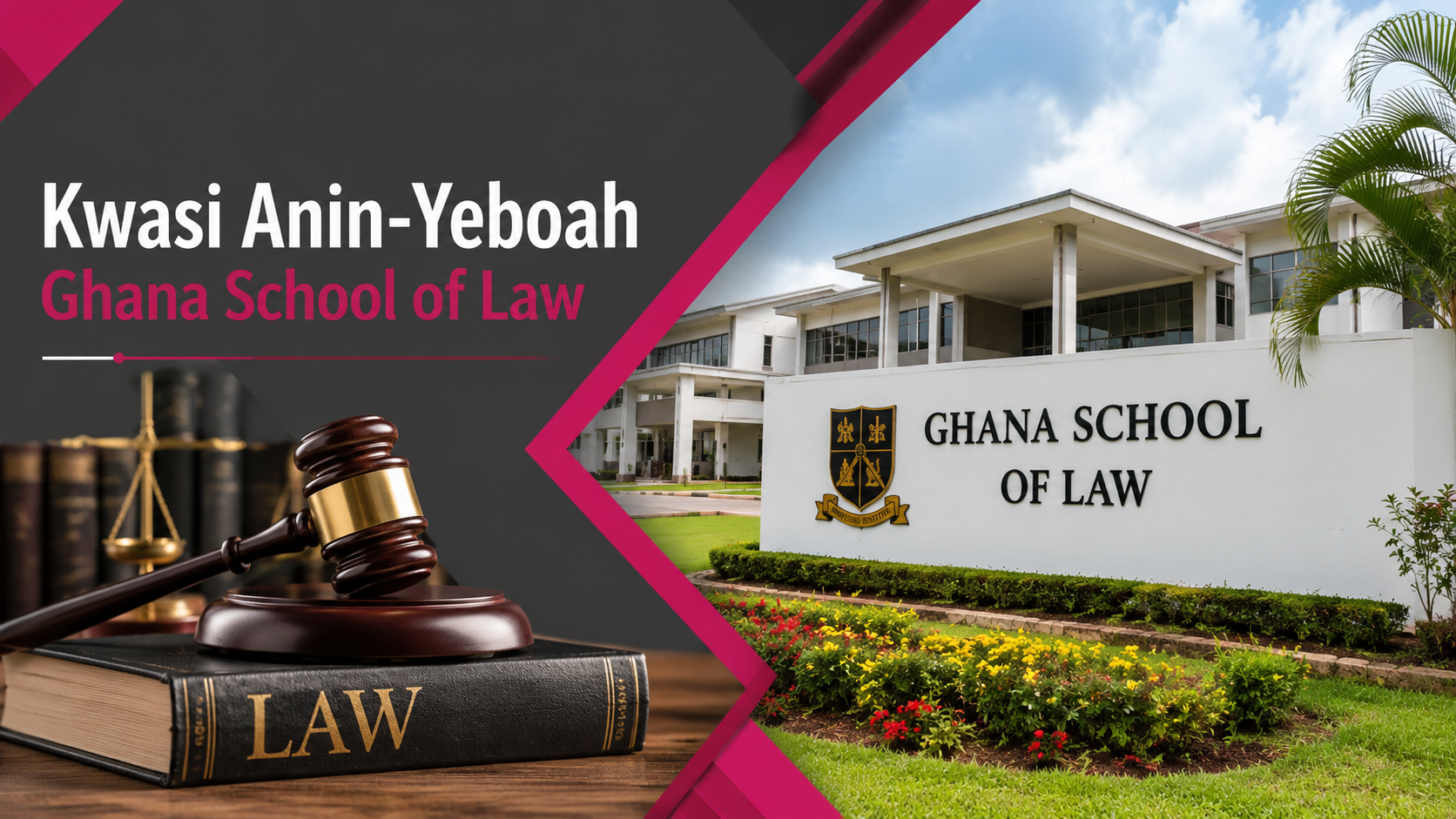
Every lawyer practicing in Ghana today walked through the same gate: the Ghana School of Law. For 66 years, it was the only route from an LLB to a wig and gown. Kwasi Anin-Yeboah passed through that gate in 1981. Four decades later, as the country’s 14th Chief Justice, he sat at the head of the institution that shaped him, chairing the General Legal Council during a period when law-school admissions, case backlogs, and calls for reform dominated legal conversation in Accra.
This guide traces his path from Toase, Ashanti Region, to the Supreme Court bench, and lays out exactly what his three years as Chief Justice meant for the Ghana School of Law and the wider judiciary. No embellishment, no invented quotes: just the record, as it stands.
Who Is Kwasi Anin-Yeboah?
Kwasi Anin-Yeboah was born on May 24, 1953, in Toase, a town in Ghana’s Ashanti Region. He completed secondary school at Amaniampong Secondary School and Apam Secondary School between 1968 and 1976, then studied law at the University of Ghana before qualifying at the Ghana School of Law, where he was called to the bar in 1981.
His early career was firmly in private and public practice, not the bench. He worked as an Assistant State Attorney at the Attorney General’s Office in Koforidua and later became a partner at Afisem Chambers, also in Koforidua’s Eastern Region. He served as President of the Eastern Regional Bar Association, a role that put him at the center of the local legal profession well before any judicial appointment.
That changed in 2002.
From the High Court to the Supreme Court
President John Kufuor appointed Anin-Yeboah to the High Court in June 2002. The promotions came quickly after that:
- Court of Appeal, September 2003
- Supreme Court of Ghana, June 2008
He spent twelve years as a Justice of the Supreme Court before his next appointment. During that stretch, he sat on some of the country’s most consequential constitutional cases, including the 2013 Election Petition, one of the most closely watched Supreme Court hearings in Ghana’s history.
Throughout his years on the Supreme Court, Anin-Yeboah also kept a foot in legal education. He worked as a part-time lecturer at the Ghana School of Law, teaching Civil Procedure and the Ghana Legal System, subjects that sit at the core of professional legal training in the country.
Appointment as Chief Justice of Ghana
In December 2019, President Nana Akufo-Addo nominated Anin-Yeboah to succeed Sophia Akuffo as Chief Justice of Ghana. Parliament approved the nomination, and he was sworn in on January 7, 2020, becoming the country’s 14th Chief Justice and the first man to hold the office in twelve years.
He would go on to chair the panel that heard the 2020 Election Petition, echoing the constitutional role he’d played as an Associate Justice in 2013, this time from the head of the bench.
The Chief Justice’s Link to the Ghana School of Law
Here’s a detail that surprises a lot of people outside the legal profession: the Chief Justice of Ghana doesn’t just oversee the courts. By virtue of the office, the Chief Justice also chairs the General Legal Council (GLC), the statutory body responsible for legal education standards, professional discipline, and admission to the Ghana School of Law.
That meant Anin-Yeboah spent his three years as Chief Justice simultaneously serving as the head of the body setting entrance requirements, curriculum standards, and disciplinary rules for every aspiring lawyer in the country.
He didn’t stay quiet about it, either.
What Anin-Yeboah Actually Said About Legal Education Reform
In December 2022, at a ceremony inducting a new Director of Legal Education at the Ghana School of Law, Anin-Yeboah addressed a problem that had been building for years: a surge in law faculties across Ghanaian universities, all feeding graduates into a single bottleneck at the professional level.
His remarks, on the record, framed the tension plainly. As GLC chairman, he said the council “cannot and dare not compromise on standards” in the face of rising numbers of law graduates, warning that lowering the bar could have serious consequences for the profession and the public it serves.
That single sentence captures the core tension of legal education policy during his tenure: demand for legal training kept climbing, while the Ghana School of Law’s capacity, and the GLC’s tolerance for lowering standards to meet that demand, did not move nearly as fast.
It’s worth being precise about what this meant in practice. Anin-Yeboah’s public position was that the Ghana School of Law’s entrance examination and quality standards should hold firm rather than expand to absorb every LLB graduate seeking admission. He was not the architect of the exam system itself, which the GLC had operated for decades before his appointment, but he was its most visible defender during a period when calls to reform or abolish it were growing louder.
The Entrance Exam Debate, In Context
The General Legal Council entrance examination has long been the single hardest step in becoming a lawyer in Ghana. In some years, pass rates have been strikingly low, a fact that fueled years of public frustration and repeated calls from students, faculty, and even members of Parliament to open up professional legal training beyond the Ghana School of Law’s exclusive control.
That pressure didn’t resolve during Anin-Yeboah’s tenure. It kept building after he left office, and it’s important for readers researching this topic to understand what came next: in 2025, Ghana’s Attorney General announced sweeping legal education reforms, and by 2026, President John Mahama had signed the Legal Education Reform Bill, formally ending the Ghana School of Law’s 66-year monopoly on professional legal training and opening the field to other accredited institutions under a new Council for Legal Education and Training.
That reform happened after Anin-Yeboah’s May 2023 retirement. Attributing it to his tenure would be inaccurate, and any article claiming otherwise is working from outdated information. His legacy on this front is narrower and more specific: he was the standard-bearer for the old system’s insistence on rigor during a period of intense pressure to change it, not the architect of the system that eventually replaced it.
Technology and the Courts: The e-Justice Rollout
Legal education wasn’t the only front where Anin-Yeboah’s Chief Justiceship intersected with reform. The Judicial Service of Ghana‘s e-Justice system, an electronic case management and filing platform, was actively expanding during his time in office.
Speaking on the impact of the e-Justice system, Anin-Yeboah described concrete gains: court users filing processes and making payments without traveling to a courthouse, lawyers receiving email notifications about adjournments, and administrators able to track case progress and generate statistics electronically.
He also pushed for the rollout of Ghana’s Case Tracking System (CTS), calling for what he described as “the fullest commitments from the various stakeholders” to expand it nationwide and sustain it long-term, a comment made at a sensitization workshop organized with USAID’s Justice Sector Support Activity.
These weren’t abstract policy statements. They reflected a judiciary in the middle of a genuine, if incremental, digital transition, one that continued to evolve after his departure.
Life After the Chief Justice’s Chair
Anin-Yeboah turned 70 on May 24, 2023, triggering the mandatory retirement age for justices of Ghana’s superior courts. He stepped down that day, having served just over three years as Chief Justice, and was succeeded by Gertrude Torkornoo.
Retirement from the Ghanaian bench didn’t mean stepping away from legal and administrative work. Anin-Yeboah had a long-running relationship with FIFA’s disciplinary and ethics structures, dating back to at least 2017, when he was appointed Chairman of FIFA’s Disciplinary Committee. In May 2025, FIFA’s Congress named him Deputy Chairperson of FIFA’s Adjudicatory Chamber for a four-year term, a role focused on reviewing ethics cases referred from FIFA’s Investigatory Chamber.
A Note on Balanced Coverage
Any serious profile of a former Chief Justice should acknowledge that public assessments of a judiciary’s leadership are rarely unanimous. Ghana’s legal community, like any other, includes voices that praised specific aspects of Anin-Yeboah’s tenure and voices that were more critical of particular rulings or administrative choices made during his time in office.
What this guide has avoided is repeating unverified allegations or one-sided characterizations, positive or negative, that can’t be traced to a credible, checkable source. Readers researching his record for academic, professional, or journalistic purposes should treat strongly-worded claims (in either direction) with the same scrutiny they’d apply to any legal record: check the primary source, check the date, and be wary of characterizations that go further than the underlying facts support.
Key Takeaways
- Kwasi Anin-Yeboah trained at the Ghana School of Law, was called to the bar in 1981, and later returned as a part-time lecturer there.
- He rose from High Court judge (2002) to Court of Appeal (2003) to the Supreme Court (2008), spending twelve years as a Justice before becoming Chief Justice.
- As Ghana’s 14th Chief Justice (January 2020 to May 2023), he chaired the General Legal Council and was a public defender of strict legal education standards amid rising demand for law school admission.
- He was not responsible for the 2025-2026 reforms that ended the Ghana School of Law’s admissions monopoly; that legislative change came after his retirement.
- He also advanced the judiciary’s e-Justice and Case Tracking System rollout during his tenure.
- He continues to serve in international legal roles, including with FIFA’s Adjudicatory Chamber.
Understanding his record means separating what he actually said and did, on the record and dated, from generalized claims about “legacy” that can’t be traced to a specific decision. That’s the standard this guide has tried to hold to, and it’s the standard worth applying to any source covering Ghana’s judiciary going forward.
Frequently Asked Questions
Did Kwasi Anin-Yeboah attend the Ghana School of Law?
Yes. He studied law at the University of Ghana and qualified at the Ghana School of Law, where he was called to the bar in 1981.
What position did Anin-Yeboah hold at the General Legal Council?
As Chief Justice of Ghana from 2020 to 2023, he chaired the General Legal Council by virtue of his office. The GLC oversees legal education standards and admission to the Ghana School of Law.
Did Kwasi Anin-Yeboah end the Ghana School of Law’s admissions monopoly?
No. That change came from the Legal Education Reform Bill, signed by President John Mahama and taking effect in 2025-2026, roughly two to three years after Anin-Yeboah’s May 2023 retirement.
When did Anin-Yeboah serve as Chief Justice of Ghana?
From January 7, 2020, to May 24, 2023, when he reached the mandatory retirement age of 70 for justices of Ghana’s superior courts.
What did Anin-Yeboah say about legal education standards?
In December 2022, as GLC chairman, he stated the council “cannot and dare not compromise on standards,” warning against lowering admission quality despite rising numbers of law graduates.
Who succeeded Anin-Yeboah as Chief Justice?Gertrude Torkornoo succeeded him following his retirement in May 2023.
What has Anin-Yeboah done since retiring from the Ghanaian judiciary?
He has continued his long-running involvement with FIFA’s disciplinary structures, being named Deputy Chairperson of FIFA’s Adjudicatory Chamber in May 2025.