
 By Tort Law Team
A plain-English guide to tort law: what it is, the three types of torts, how negligence works, and what damages you can recover in a civil liability case.
The U.S. personal injury law market generated $61.3 billion in revenue in 2024, yet only 4% of those cases ever reach a courtroom. Millions of people suffer civil wrongs every year without knowing what legal rights they hold or how the system works.
That gap is what this tort law legal guide is here to close. Whether you’re a law student cracking open your first casebook, a small business owner wondering about your liability exposure, or someone who just got hurt and wants to understand your options, this guide walks you through everything: what a tort is, the three major categories, how to prove negligence, what damages look like, and how real cases play out. No law degree required.
TL;DR
Tort law is the body of civil law that lets injured parties seek compensation from whoever wronged them. There are three categories: intentional torts (deliberate harmful acts), negligence (careless conduct that causes harm), and strict liability (liability regardless of fault, common in product liability cases). To win a negligence claim, a plaintiff must prove duty of care, breach, causation, and damages. Remedies range from compensatory damages covering medical bills and lost wages to punitive damages in egregious cases. Tort law is separate from criminal law: the burden of proof is lower, and the goal is compensation rather than punishment.
What is tort law?
A tort is a civil wrong, other than a breach of contract, that causes someone to suffer harm and creates legal liability for the person who committed it. The word comes from the Latin “tortus,” meaning twisted or crooked, which captures the idea nicely: someone deviated from how they should have behaved, and someone else paid for it.
Tort law serves three main purposes. First, it compensates victims for their losses. Second, it holds wrongdoers accountable. Third, it deters harmful behavior by making people financially responsible for the damage they cause. Courts interpret each case on its facts, but the Restatement of Torts provides an influential guiding framework that most U.S. jurisdictions reference.
What tort law is not is equally important. It’s not contract law (which only covers duties people voluntarily agreed to), and it’s not criminal law (which is prosecuted by the state). Tort law is a private citizen suing another private party for compensation.
Tort law vs. criminal law
People often confuse tort cases with criminal prosecutions, and the confusion is understandable: both involve harmful conduct and both take place in courtrooms.
But the mechanics are completely different. In a tort case, the injured party (the plaintiff) brings the lawsuit and seeks money damages. In a criminal case, the government prosecutes the defendant and seeks punishment, which can include imprisonment. The burden of proof is also different: tort cases use a preponderance of the evidence standard, meaning it just has to be more likely than not (greater than 50%) that the defendant is liable. Criminal cases require proof beyond a reasonable doubt, a far higher bar.
| Tort Law | Criminal Law | |
|---|---|---|
| Who brings the case | Private plaintiff | Government |
| Goal | Compensate the victim | Punish the offender |
| Burden of proof | Preponderance of evidence | Beyond reasonable doubt |
| Outcome | Money damages, injunction | Imprisonment, fines, probation |
The same act can trigger both. A person who commits battery may be criminally prosecuted by the state and sued in a civil tort action by the victim, each proceeding independently.
The origins of civil wrongs
Tort law developed through the English common law tradition, where courts gradually recognized that individuals harmed by the wrongful acts of others had a right to compensation. Early tort actions focused on trespass: you crossed onto my land, you struck me without permission, you took my property. Over centuries, courts expanded the concept to cover a much wider range of civil wrongs, including negligence, defamation, and products liability.
Today, tort cases are primarily governed by state law, and the rules vary somewhat from one jurisdiction to another. But the core categories and principles are consistent across the country.
The three types of torts
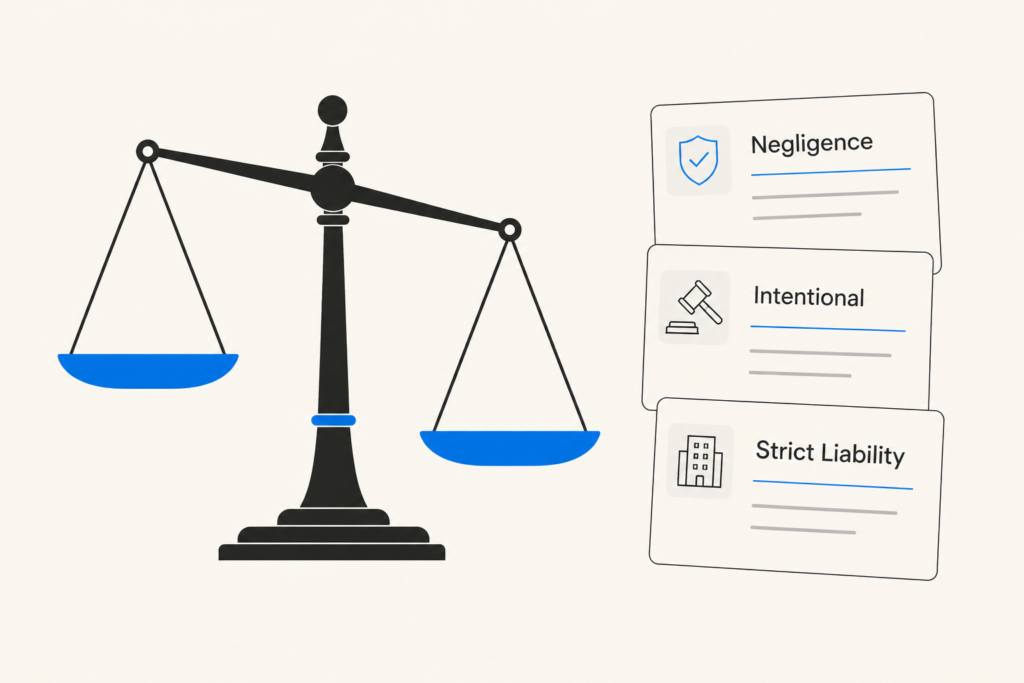
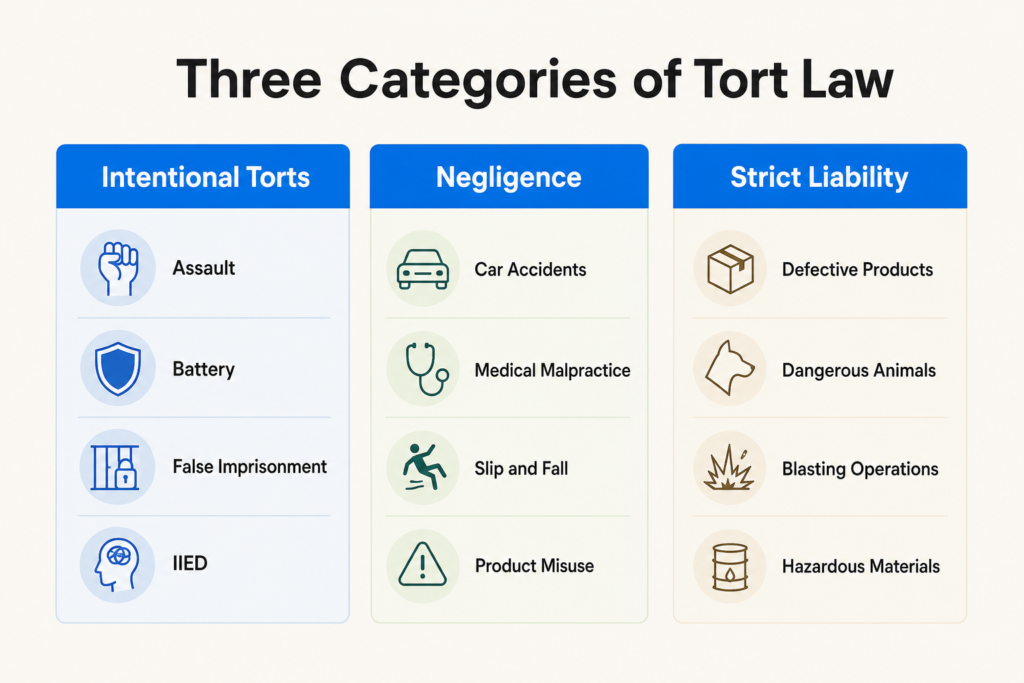
All torts fall into one of three categories based on what the defendant was thinking (or not thinking) when the harm occurred.
Intentional torts
Intentional torts occur when a defendant deliberately acts in a way that causes harm. Notice the word “deliberately” applies to the act, not necessarily the harm. A defendant who pulls a chair out from under someone as a prank commits battery even if they didn’t intend for the person to get injured, as long as the act itself was intentional.
Common intentional torts include assault (causing someone to reasonably fear imminent harmful contact), battery (actually making that contact), false imprisonment (unlawfully confining someone), trespass to land, and intentional infliction of emotional distress. We’ll go deeper on each of these shortly.
Negligence: the most common path to liability
Negligence is the failure to act with the level of care that a reasonable person would exercise under the same circumstances. It’s the most litigated category of tort law, covering everything from car accidents to slip-and-falls to medical malpractice.
Negligence doesn’t require intent. A distracted driver who runs a red light and injures a pedestrian didn’t mean to hurt anyone, but they still failed to meet the standard of care that driving requires. That failure creates liability.
Strict liability torts
Strict liability is the most unusual category because it removes fault from the equation entirely. A defendant can be held liable even if they took every reasonable precaution and had no intention of causing harm.
Strict liability typically applies to three situations: product liability cases involving defective products, abnormally dangerous activities (like commercial blasting or storing explosives), and injuries caused by certain animals. The rationale is straightforward: some activities are so inherently risky that whoever engages in them should bear the cost of any resulting harm, regardless of how carefully they acted.
The four elements of a negligence claim
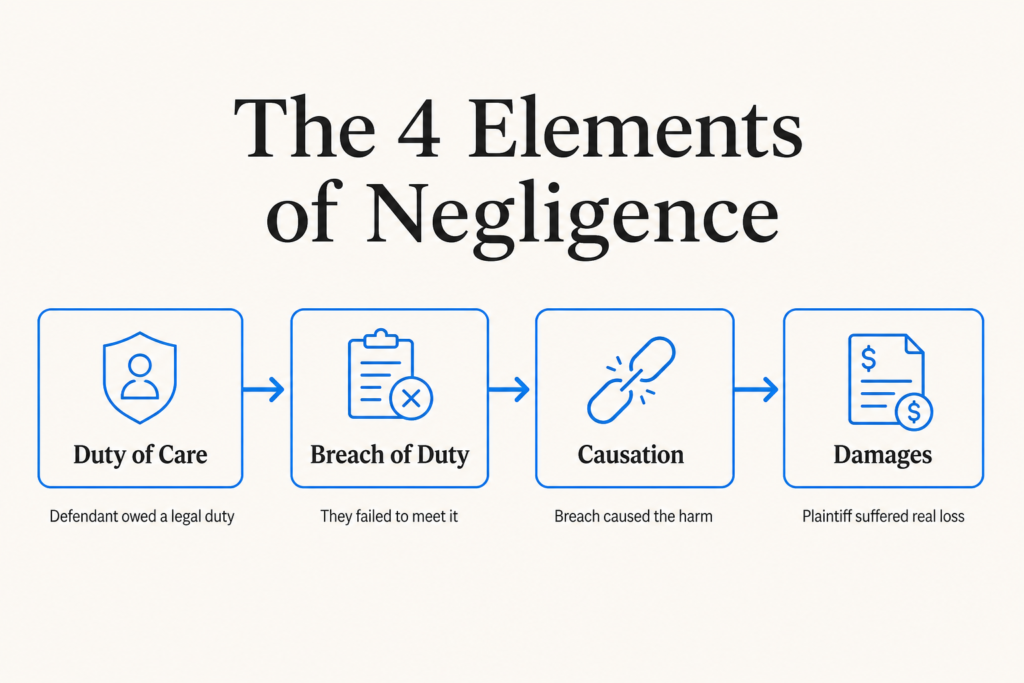
Negligence is the most complex category to prove, and it’s where most tort litigation concentrates. To win, a plaintiff must establish four distinct elements.
Duty of care
Duty of care is the legal obligation to act with reasonable caution toward others who might foreseeably be harmed by your conduct. It’s the foundation of every negligence claim, and if it doesn’t exist, the case ends there.
Some duties are obvious. Drivers have a duty of care to other road users. Doctors have a duty of care to patients. Property owners have a duty of care to visitors on their premises. Courts determine whether a duty exists based on the relationship between the parties, the foreseeability of harm, and broader public policy considerations.
The landmark Donoghue v. Stevenson (1932) case established the modern duty of care principle. A woman drank ginger beer that contained a decomposed snail and became ill. The court held that the manufacturer owed her a duty of care even though she had no contract with them: if you put a product into the world knowing it will reach consumers, you owe those consumers a duty not to be careless.
Breach of duty
Once a duty exists, the next question is whether the defendant breached it. A breach of duty occurs when the defendant fails to exercise the standard of care that a reasonable person would have used in the same situation.
Courts sometimes apply the Hand Formula, developed by Judge Learned Hand in United States v. Carroll Towing Co. (1947). It says a breach occurs when the burden of taking precautions (B) is less than the probability of harm (P) multiplied by the severity of potential injury (L). If B < PL, the defendant breached their duty. This economic framework encourages people to take cost-effective safety measures, but doesn’t require eliminating every conceivable risk.
Causation
Proving causation is actually two separate tasks. First, the plaintiff must show actual causation (also called cause-in-fact) by satisfying the “but-for” test: would the injury have occurred but for the defendant’s conduct? If the answer is no, actual causation is established.
Second, the plaintiff must show proximate cause, meaning the harm was a foreseeable result of the defendant’s breach. Proximate cause limits liability to harms that naturally and reasonably follow from the negligent act. It prevents defendants from being held responsible for bizarre, unforeseeable chain reactions.
The classic proximate cause case is Palsgraf v. Long Island Railroad Co. (1928). A railroad guard helped a passenger board a moving train, causing the passenger to drop a package of fireworks, which exploded and knocked over scales at the other end of the platform, injuring Mrs. Palsgraf. The court ruled the railroad was not liable to her because the harm was not a foreseeable result of helping a passenger board a train.
Damages
The plaintiff must have suffered actual, recognizable harm. This is what separates a close call from a tort claim. If a driver runs a red light but nobody gets hurt, there’s no negligence claim, even if the driver was clearly careless.
Damages in negligence cases include personal injuries (physical harm), property damage, economic losses like medical bills and lost wages, and sometimes non-economic harms like pain and suffering.
Common intentional torts explained
Assault and battery
People often say “assault and battery” as if it’s one thing. In tort law, they’re two distinct wrongs. Assault is an intentional act that causes the victim to reasonably apprehend imminent harmful or offensive contact. No physical contact is required: pointing a loaded gun at someone and demanding their wallet is assault, even if you never fire.
Battery is the actual harmful or offensive contact. The defendant must intend the contact (though not necessarily the resulting harm), and the contact must be one that would offend a reasonable person’s sense of personal dignity. Importantly, contact can extend to things closely connected to the person, like knocking a book out of someone’s hands.
Under the eggshell skull rule, a defendant is liable for all consequences of battery even if the victim had a pre-existing condition that made the injury far worse than it would have been for a typical person. If you shove someone who has an undisclosed bone disease and they suffer a catastrophic fracture, you’re liable for the full extent of the harm.
False imprisonment
False imprisonment occurs when a defendant intentionally restricts another person’s movement within a bounded area without consent or legal authority, and the victim is aware of the confinement. The restraint doesn’t have to involve physical force: locking a door, making credible threats, or misusing legal authority all qualify.
One important defense is the shopkeeper’s privilege. A store owner who reasonably suspects a customer of shoplifting can detain them for a reasonable time and in a reasonable manner to investigate. The detention must be proportionate and professional; anything beyond that crosses into false imprisonment.
Intentional infliction of emotional distress (IIED)
Intentional infliction of emotional distress (IIED) is one of the harder torts to prove because the conduct must cross a very high threshold. To succeed, a plaintiff must show that the defendant engaged in conduct that was “extreme and outrageous,” intentionally or recklessly causing severe emotional distress.
The “extreme and outrageous” standard is deliberately demanding. Courts recognize that people must be able to handle ordinary rudeness, insults, and annoyances without running to a courthouse. The conduct has to go well beyond what’s socially unacceptable. Persistent harassment campaigns, deliberate threats designed to terrorize, or cruelty targeting someone’s known vulnerabilities can clear the bar.
There are also First Amendment limits on IIED claims involving public figures and matters of public concern, as the Supreme Court addressed in Snyder v. Phelps (2011).
Strict liability and product liability
When intent doesn’t matter
The distinguishing feature of strict liability torts is that a defendant’s mental state is irrelevant. A manufacturer who produces a product with a hidden defect is liable for resulting injuries even if they took every precaution and had no idea the defect existed. That might seem harsh, but the policy logic is sound: manufacturers are better positioned than consumers to detect and guard against defects, and the cost of injuries should fall on the party in the best position to prevent them.
Defective product claims
Product liability is the most common form of strict liability litigation. When a defective product injures a consumer, the injured party can sue the manufacturer, distributor, or retailer under one of three defect theories.
A manufacturing defect occurs when a specific unit deviates from the product’s intended design: a car’s brake line that was improperly crimped during production, for example. A design defect occurs when the entire product line is inherently unsafe as designed, even when built correctly. A failure-to-warn defect (also called a marketing defect) occurs when the product lacks adequate warnings or instructions about known risks.
To establish a product liability claim, the plaintiff typically needs to show: the defendant sold or distributed the product commercially, the product was defective when it left the defendant’s control, the plaintiff used the product in a reasonably foreseeable way, and the defect caused the plaintiff’s injury.
Medical malpractice: negligence in healthcare
Medical malpractice is a specialized form of negligence that occurs when a healthcare provider fails to meet the accepted standard of care in their field, causing harm to a patient. It’s one of the most complex areas of tort litigation, partly because “standard of care” in medicine requires expert testimony to establish.
The plaintiff must show that a doctor-patient relationship existed, that the provider deviated from the accepted standard of care (what a competent practitioner in the same specialty would have done), that the deviation caused the patient’s injury, and that the injury resulted in quantifiable damages.
Medical malpractice claims have a notoriously high bar. Roughly 8% of medical malpractice cases go to trial, compared to about 3% of car accident tort cases, and plaintiffs win only about half of those trials. Expert witnesses on both sides are essential, which also makes these cases expensive to litigate.
Many states have enacted caps on pain and suffering damages in medical malpractice cases specifically, though the caps vary widely. California’s Medical Injury Compensation Reform Act (MICRA) historically capped non-economic damages at $250,000 (though this was increased in 2023 under AB 35 to phase up over time).
Legal remedies and damages in tort cases
If a plaintiff wins a tort case, the court awards one or more forms of relief.
Compensatory damages
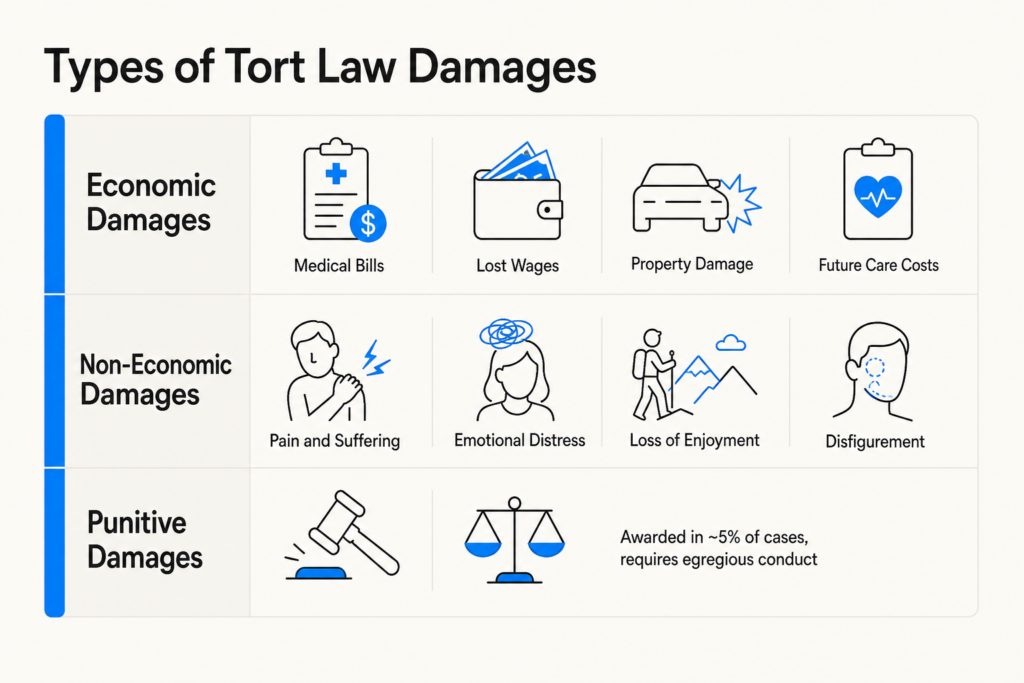
Compensatory damages are the core remedy in tort law. Their goal is to restore the plaintiff, as closely as money can, to the position they would have been in if the tort never occurred.
Economic damages cover quantifiable financial losses: medical expenses (past and future), lost wages, lost earning capacity, property damage, and out-of-pocket costs. These are calculated with relative precision using bills, pay stubs, and expert projections.
Non-economic damages compensate for harms that don’t have a price tag: pain and suffering, emotional distress, loss of enjoyment of life, and disfigurement. Because there’s no market for these losses, courts use methods like the “multiplier method” (multiplying economic damages by a factor of 1.5 to 5) or the “per diem method” (assigning a dollar amount to each day of suffering). The resulting figures vary widely between cases and jurisdictions.
Punitive damages
Punitive damages serve a different purpose: punishment and deterrence. They’re awarded on top of compensatory damages when the defendant’s conduct was particularly egregious, intentional, or recklessly indifferent to others’ rights.
Courts award punitive damages in only about 5% of tort verdicts. When they do, the Supreme Court has imposed constitutional limits. In BMW of North America, Inc. v. Gore (1996), the Court struck down a $4 million punitive award against a $4,000 actual harm as constitutionally excessive. State Farm v. Campbell (2003) further held that punitive damages should generally not exceed a single-digit multiple of compensatory damages.
Other remedies
Money isn’t always the right answer. Courts can also grant injunctive relief, a court order compelling the defendant to stop certain conduct or to take specific action. Injunctions are common in nuisance cases (ordering a factory to stop dumping pollutants) and in cases where ongoing harm would be difficult to quantify in dollars.
Courts can also award nominal damages when a plaintiff’s legal right was violated but no actual financial harm resulted. These awards, sometimes just one dollar, serve to formally acknowledge that a wrong occurred.
Famous tort cases that shaped the law
The McDonald’s Hot Coffee Case (Liebeck v. McDonald’s, 1994) is probably the most misunderstood tort case in American history. Stella Liebeck, 79, suffered third-degree burns over 6% of her body after spilling McDonald’s coffee that was served at 180-190 degrees Fahrenheit. Internal documents showed McDonald’s knew its coffee caused burn injuries and had received over 700 prior complaints. The jury initially awarded $2.7 million in punitive damages (later reduced to $480,000 on appeal). The case was not about a “clumsy woman suing over hot coffee.” It was about a corporation that knowingly continued a dangerous practice after repeated warnings.
Donoghue v. Stevenson (1932) gave us the modern duty of care doctrine. A Scottish woman found a decomposed snail in her ginger beer and became ill. Her friend had bought the drink, so she had no contract with the manufacturer. The House of Lords held that manufacturers owe a duty of care to end consumers regardless of contract, establishing the “neighbour principle” that still underpins negligence law today.
Palsgraf v. Long Island Railroad Co. (1928) remains the definitive case on proximate cause. It established that a defendant is only liable for harms that were a reasonably foreseeable consequence of their negligent act, not for every harm in the causal chain, however distant. Law students have been wrestling with the scales-and-fireworks fact pattern ever since.
Defenses against tort claims
Winning a tort case isn’t automatic even when the plaintiff proves all the elements. Defendants have several available defenses.
Comparative negligence reduces the plaintiff’s recovery by their share of fault. If a plaintiff was 30% responsible for a car accident and suffered $100,000 in damages, they can recover $70,000. Most states follow a “modified comparative negligence” rule that bars recovery entirely if the plaintiff was 50% or 51% or more at fault.
Contributory negligence is the old common law rule: if the plaintiff was at all at fault, they recover nothing. Only a handful of states (Alabama, Maryland, North Carolina, and Virginia) still follow this rule. It’s harsh, which is why most jurisdictions replaced it.
Assumption of risk applies when the plaintiff voluntarily encountered a known risk. Signing a waiver before a skydiving jump is an express assumption of risk. Participating in a contact sport carries an implied assumption of the ordinary risks of that activity.
The statute of limitations bars claims filed too late. Most personal injury tort claims must be brought within 2 to 3 years of the date of injury, though the “discovery rule” can toll (pause) the clock in cases where the injury wasn’t immediately apparent.
Consent defeats intentional tort claims where the plaintiff agreed to the contact. A boxing match is the clearest example: the participants consent to being hit within the rules of the sport.
How to bring a tort claim: a step-by-step overview
Understanding how tort litigation works in practice helps demystify the process.
Step 1: Identify the tort and the defendant. Figure out which category of tort applies, who caused the harm, and whether they have assets or insurance to satisfy a judgment. Filing a claim against a judgment-proof defendant is generally not worth the effort.
Step 2: Preserve evidence. Document everything immediately: photographs of the scene and injuries, medical records, incident reports, witness contact information, and any communications with the defendant. Evidence degrades fast.
Step 3: Consult a tort attorney. Most personal injury attorneys work on a contingency fee basis (they take a percentage of any recovery, typically 33%, and charge nothing if you lose). The initial consultation is usually free. An attorney will assess whether your claim is viable before you invest any time or money.
Step 4: File a complaint. Your attorney drafts and files a complaint in the appropriate civil court, alleging the specific tort and the damages sought. The defendant is served and must respond.
Step 5: Discovery. Both sides exchange evidence: documents, interrogatories (written questions), and depositions (sworn testimony). This phase reveals the strength of each party’s case and is often when settlement negotiations get serious.
Step 6: Settlement or trial. Only about 4% of personal injury cases go to trial. Most liability cases settle during or after discovery, once the parties have a clearer picture of the evidence. If the case goes to trial, a jury or judge determines liability and damages.
Step 7: Collection. Winning a judgment is not the same as getting paid. If the defendant doesn’t have insurance or liquid assets, collection can be difficult. This is why assessing the defendant’s ability to pay is part of the initial case evaluation.
What this means for you
Tort law isn’t just academic. If you’re a small business owner, you face potential liability for injuries on your premises, negligence by your employees, and defective products you manufacture or sell. If you’ve been hurt, understanding tort law tells you what you need to prove, how long you have to act, and what compensation you can realistically expect.
Understanding the basic elements of a tort law claim and how courts evaluate them is the first step toward protecting your rights or defending against claims. The law in this area is sophisticated, fact-specific, and deeply shaped by precedent that varies from state to state.
If you believe you have a tort claim, or you’re facing one, consulting a licensed attorney in your jurisdiction is the most important step you can take. This guide gives you the map; a qualified attorney knows the local roads.
This article is for informational and educational purposes only. It does not constitute legal advice, and no attorney-client relationship is formed by reading it. For advice on a specific legal matter, consult a licensed attorney in your jurisdiction.
Frequently Asked Questions
What is the difference between tort law and criminal law?
Tort law is a branch of civil law where a private individual sues another for compensation after suffering harm. Criminal law is prosecuted by the government and can result in imprisonment or fines. The burden of proof differs too: tort cases require a preponderance of the evidence (more likely than not), while criminal cases require proof beyond a reasonable doubt. The same act, such as battery, can trigger both a civil tort claim and a criminal prosecution.
What are the basic elements of a tort law claim?
Most tort claims require three basic elements:
(1) The defendant engaged in wrongful conduct.
(2) That conduct caused the plaintiff’s injury.
(3) The plaintiff suffered actual damages.
For negligence specifically, courts require four elements: duty of care, breach of that duty, causation, and damages. Intentional torts add a requirement that the defendant acted with intent to cause the contact or harm.
What types of damages can you recover in a tort case?
Tort law offers several categories of damages. Compensatory damages cover economic losses (medical bills, lost wages, property damage) and non-economic losses (pain and suffering, emotional distress). Punitive damages are awarded in roughly 5% of cases where the defendant’s conduct was especially egregious. Courts may also grant injunctive relief, ordering the defendant to stop certain harmful conduct. The exact amount depends on the severity of harm, the defendant’s conduct, and applicable state law.
What is strict liability in tort law?
Strict liability is a category of tort law where a defendant can be held liable for harm without any requirement to prove negligence or intent. It applies in specific situations: product liability cases involving defective products, abnormally dangerous activities like blasting, and injuries caused by certain animals. In a strict liability case, the plaintiff only needs to prove the activity occurred, that the product was defective when sold, or that the defendant owned the animal, and that the harm resulted.
How long do you have to file a tort claim?
The time limit to file a tort claim is set by your state’s statute of limitations. Most personal injury tort claims must be filed within 2 to 3 years of the date of injury. Medical malpractice claims often have shorter windows, sometimes as little as 1 to 2 years. Some states apply a ‘discovery rule,’ which starts the clock when you discovered (or reasonably should have discovered) the injury. Missing the deadline almost always bars your claim entirely, so acting promptly is critical.