
 By Tort Law Team
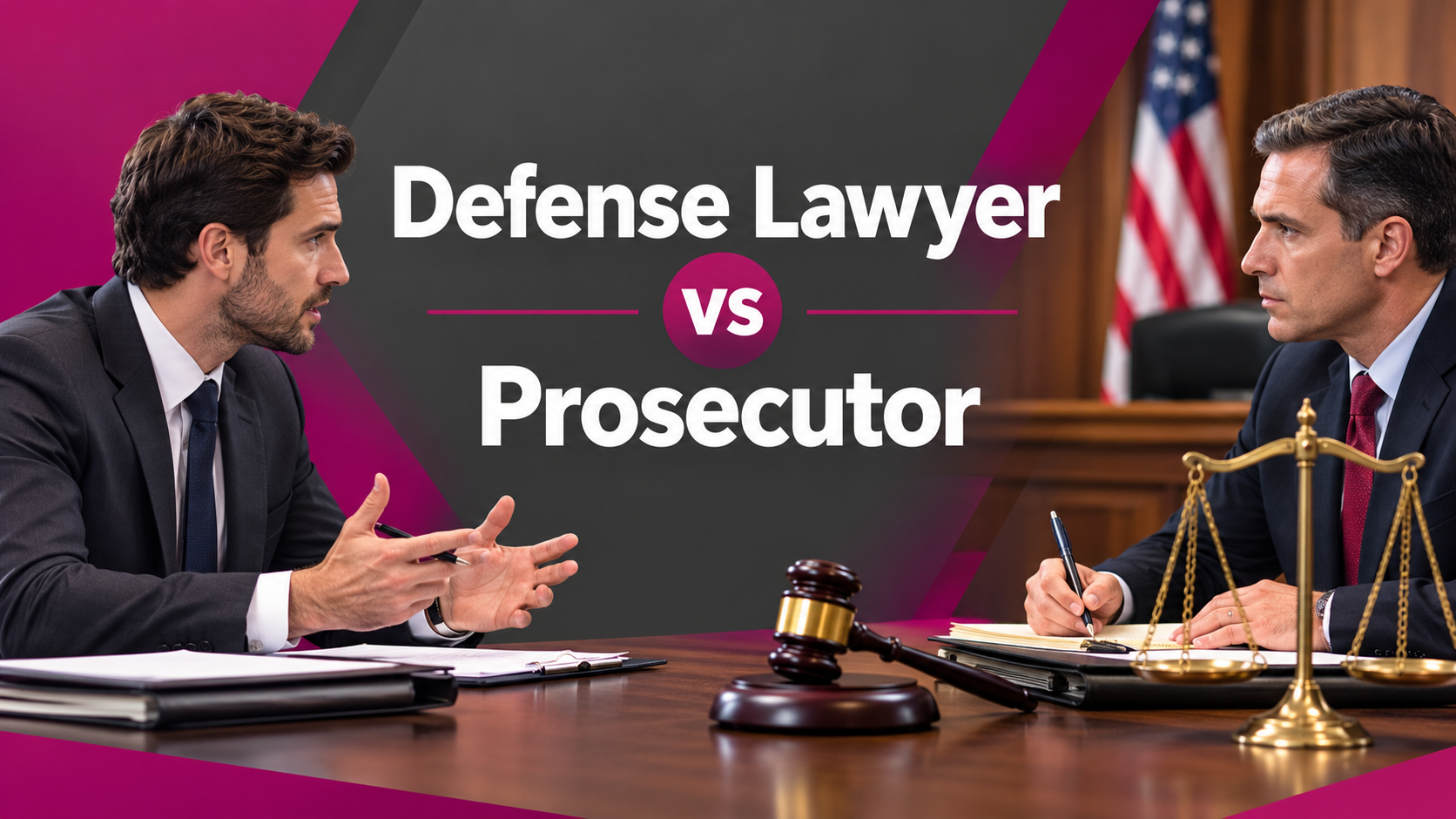
Nearly 95 percent of felony convictions in the United States result from guilty pleas rather than full trials. That single statistic shows how often the criminal justice system resolves cases before a jury ever deliberates. Yet many people facing charges, or simply curious about how courts work, still picture two lawyers locked in dramatic courtroom combat without understanding what each side actually does.
This article explains the core differences between a defense lawyer and a prosecutor. You will see who each one represents, what goals drive their work, how the adversarial process shapes every stage of a case, and why the burden of proof rests so heavily on one side. The goal is straightforward: help you understand courtroom dynamics, constitutional rights, and the practical realities of legal representation when criminal charges are on the line.
Who Represents Whom in the Criminal Justice System
The most fundamental difference is the client each lawyer serves.
A prosecutor works for the government. At the local level this person is often called a district attorney or state’s attorney. In federal court the role belongs to a United States Attorney or an assistant. The client is not an individual victim. The client is the public, or more precisely the state or federal government acting on behalf of society. Prosecutors review evidence gathered by police, decide whether to file criminal charges, choose which charges to pursue, and present the case in court.
A defense lawyer represents only the person accused of the crime. That person is the client, full stop. The lawyer’s loyalty runs to that individual. Defense counsel may be a private attorney hired by the client, a public defender paid by the government to represent people who cannot afford counsel, or a court-appointed lawyer. The Sixth Amendment guarantees the right to counsel in criminal cases that carry the possibility of incarceration, so the system provides representation even when the accused has no money.
This distinction shapes everything that follows. The prosecutor answers to the public interest and to ethical rules that require seeking justice rather than simply winning. The defense lawyer answers to the client and must provide zealous advocacy within the bounds of the law.
Public Prosecutor vs Private Defense Attorney
Prosecutors are almost always government employees. Their offices handle large volumes of cases and operate under policies set by elected or appointed leaders. Defense lawyers work in more varied settings. Private firms charge fees and often specialize in certain types of cases. Public defender offices serve indigent clients and frequently carry heavy caseloads. Court-appointed attorneys fill gaps when public defenders have conflicts of interest.
The difference in resources can be noticeable. Prosecutors typically have access to police investigators, forensic labs, and government databases. Defense teams, especially public ones, often operate with tighter budgets and must request discovery materials from the other side. Despite these practical gaps, both sides are bound by the same constitutional rules that protect the accused.
The Adversarial Process Explained
American criminal courts follow an adversarial process. Each side presents its strongest case, and a neutral judge or jury decides the outcome. The system assumes that truth emerges more reliably when opposing advocates test each other’s evidence than when a single official investigates and decides.
In this structure the prosecutor presents the government’s case first. The defense then challenges that case through cross-examination, objections, motions to exclude evidence, and, when helpful, its own witnesses and exhibits. The judge referees the rules of evidence and procedure. The jury, if one is sitting, determines the facts.
This contest is not a free-for-all. Constitutional protections limit what the government can do. The Fourth Amendment restricts unreasonable searches and seizures. The Fifth Amendment protects against self-incrimination and guarantees due process. The Sixth Amendment secures the right to counsel, a speedy and public trial, confrontation of witnesses, and compulsory process for obtaining favorable evidence. Defense lawyers invoke these rights constantly. Prosecutors must respect them or risk having evidence thrown out or cases dismissed.
Burden of Proof: The Prosecutor’s Heavy Lift
No difference between the two roles is more important than the burden of proof.
In every criminal case the prosecution must prove the defendant’s guilt beyond a reasonable doubt. This is the highest standard of proof in American law. It requires the government to establish every element of the charged offense to a level of near certainty. The defense does not have to prove innocence. The defense does not have to present any evidence at all. If the prosecutor fails to meet the standard, the jury must acquit.
The Supreme Court rooted this requirement in the Due Process Clause. In In re Winship the Court held that the Constitution demands proof beyond a reasonable doubt of every fact necessary to constitute the crime. The presumption of innocence remains in force from the moment charges are filed until a conviction is entered.
There is a limited exception. When a defendant raises an affirmative defense such as self-defense, insanity, or entrapment, the defense may carry a burden of production or even persuasion on that specific issue. Even then, the prosecution still must prove the underlying elements of the crime beyond a reasonable doubt. The standard for most affirmative defenses is lower than the prosecution’s burden, often a preponderance of the evidence.
This allocation of the burden protects individual liberty. Because the state can take away freedom, the state must meet the highest evidentiary bar.
What Prosecutors Actually Do Day to Day
Prosecutors perform a wide range of tasks long before any trial begins.
They review police reports and decide whether the evidence supports probable cause for charges. They choose the specific statutes to charge and the severity of those charges. They may present cases to grand juries for indictment in felony matters. They negotiate plea bargaining agreements, which resolve the overwhelming majority of cases. They disclose evidence to the defense as required by law and ethical rules. At trial they call witnesses, introduce physical and documentary evidence, and argue that the facts meet the legal elements of the crime.
Ethically, a prosecutor’s primary duty is to seek justice, not merely to convict. The American Bar Association’s Criminal Justice Standards state that the prosecutor is an administrator of justice and an officer of the court. The Supreme Court expressed the same idea decades earlier in Berger v. United States: the government’s interest “is not that it shall win a case, but that justice shall be done.”
That duty includes the constitutional obligation established in Brady v. Maryland. Prosecutors must turn over material evidence favorable to the accused, whether that evidence goes to guilt or to punishment. Failure to disclose can lead to reversed convictions and professional discipline.
Prosecutors also exercise broad discretion. They decide which cases to pursue, which to dismiss, and what plea offers to make. That power is constrained by policy manuals, ethical rules, and judicial oversight, yet it remains one of the most significant features of the system.
What Defense Lawyers Actually Do Day to Day
Defense lawyers begin work as soon as a client is arrested or learns of an investigation. They advise the client on whether to speak with police, assert the right to remain silent, and request counsel. They investigate the facts independently when resources allow, interview witnesses, and gather documents the government may have overlooked.
They file pretrial motions to suppress evidence obtained in violation of the Constitution, to dismiss charges for lack of probable cause, or to compel discovery. They negotiate with prosecutors over possible plea agreements, explaining the strengths and weaknesses of the case to the client so the client can make informed decisions. At trial they cross-examine government witnesses, challenge the reliability of forensic evidence, present defense witnesses when helpful, and argue that the prosecution has not met its burden.
The ethical core of the defense role is loyalty to the client. Attorney-client privilege and the duty of confidentiality protect nearly everything the client tells the lawyer. A defense attorney can and often does represent someone the lawyer personally believes is guilty. The system requires an advocate for every accused person precisely so that the government is forced to prove its case.
There are limits. A defense lawyer may not assist a client in committing a crime, present false evidence, or allow a client to commit perjury. Within those boundaries the duty is zealous representation.
Courtroom Dynamics and Trial Proceedings
When a case reaches trial the contrasting roles become visible in real time.
The prosecutor delivers an opening statement that outlines the expected evidence of guilt. The defense opening usually focuses on the presumption of innocence and the gaps or inconsistencies the defense expects to highlight. The government presents its case first. The defense cross-examines each witness, testing credibility, memory, and bias. After the prosecution rests, the defense may move for a judgment of acquittal if the evidence is legally insufficient. If the motion is denied, the defense may present its own case or simply rest and argue that the government failed to prove guilt beyond a reasonable doubt.
Closing arguments follow. The prosecutor argues that the evidence establishes guilt. The defense argues that reasonable doubt remains. The judge instructs the jury on the law, including the burden of proof and the presumption of innocence. The jury deliberates and returns a verdict.
Throughout these trial proceedings the judge acts as neutral referee. Objections are ruled upon, evidence is admitted or excluded, and the jury is protected from improper argument. The entire process is designed to test the government’s case under adversarial pressure while safeguarding constitutional rights.
Plea Bargaining: Where Most Cases End
Full trials are rare. Research consistently shows that roughly 90 to 98 percent of criminal convictions result from guilty pleas, most of them reached through plea bargaining. In federal court the figure approaches 97 percent of convictions. State courts show similar patterns.
In a plea negotiation the prosecutor typically offers reduced charges or a recommended sentence in exchange for a guilty plea and a waiver of the right to trial. The defense lawyer evaluates the offer against the strength of the evidence, the likely outcome at trial, and the client’s priorities. The client alone decides whether to accept the offer, go to trial, or continue negotiating.
Plea bargaining conserves court resources and provides certainty for both sides. Critics note that it can pressure defendants, especially those held in pretrial detention, to accept deals rather than risk longer sentences after a trial conviction. Defense lawyers play a critical role in ensuring clients understand the consequences and that any agreement is knowing and voluntary.
Legal Ethics That Shape Both Roles
Both prosecutors and defense lawyers are bound by rules of professional conduct, but the rules apply differently because the roles differ.
Prosecutors face heightened duties. They must not pursue charges they know lack probable cause. They must ensure defendants are advised of the right to counsel. They must disclose evidence favorable to the defense. They must refrain from making improper public comments that could prejudice a case. When new evidence suggests a possible wrongful conviction, many jurisdictions require prosecutors to investigate and disclose it.
Defense lawyers owe undivided loyalty to the client. They must communicate promptly, keep the client informed, and follow the client’s decisions on whether to plead, whether to testify, and whether to waive a jury. They must maintain confidentiality and avoid conflicts of interest. They may not knowingly present false evidence or assist in ongoing criminal activity.
These ethical frameworks reinforce the structural balance of the system. The prosecutor’s duty to justice prevents the government from pursuing convictions at any cost. The defense lawyer’s duty to the client ensures that every accused person has a vigorous advocate testing the government’s proof.
How Criminal Defense Lawyers Protect Constitutional Rights
Defense counsel is often the primary mechanism through which constitutional protections become real.
A skilled defense lawyer challenges unlawful searches and seizures under the Fourth Amendment. The lawyer asserts the Fifth Amendment privilege against self-incrimination and objects when interrogations violate Miranda warnings. The lawyer demands the confrontation rights guaranteed by the Sixth Amendment and files motions when the government fails to provide required discovery. In capital cases or cases involving severe sentences, defense counsel investigates mitigation evidence that can affect sentencing outcomes.
These actions do more than protect one client. They create a body of case law that constrains government power for everyone. When courts suppress illegally obtained evidence or reverse convictions for Brady violations, the rulings shape future police and prosecutorial practices.
Common Misconceptions About the Two Roles
Several myths persist.
One is that prosecutors “win” only by securing convictions. In reality ethical prosecutors dismiss weak cases, reduce charges when evidence does not support the original accusation, and sometimes recommend leniency. Another myth is that defense lawyers help guilty people escape justice. The system requires representation for the guilty and the innocent alike so that the government remains accountable to proof beyond a reasonable doubt. A third misconception is that public defenders are inherently less capable than private counsel. Many public defenders are highly skilled and deeply experienced; caseload size is often the greater practical constraint.
Understanding these realities helps people facing charges make better decisions and helps students and observers evaluate the system more accurately.
Side-by-Side Comparison of Core Differences
| Aspect | Prosecutor | Defense Lawyer |
|---|---|---|
| Client | Government / public | Individual accused |
| Primary goal | Seek justice, prove guilt beyond reasonable doubt | Protect rights, achieve best outcome for client |
| Burden of proof | Carries the full burden | Generally carries none |
| Ethical focus | Duty to justice and disclosure | Zealous advocacy and confidentiality |
| Employment | Government office | Private practice, public defender, or appointed |
| Discretion | Charging and plea offers | Strategy within client’s decisions |
Why the Difference Matters for Ordinary People
If you or someone close to you faces criminal charges, the distinction is immediate and practical. You need a defense lawyer, not a prosecutor. The prosecutor works for the government that is bringing the case against you. Your lawyer works for you.
For students of the criminal justice system, the comparison illustrates how the Constitution structures power. The government holds vast investigative and charging authority. The defense role and the high burden of proof act as deliberate counters to that authority.
For anyone interested in courtroom dynamics, the interplay between the two sides explains why trials look the way they do, why most cases resolve through negotiation, and why constitutional rights are not self-executing. They require advocates willing and able to enforce them.
Conclusion
A defense lawyer and a prosecutor stand on opposite sides of every criminal case. The prosecutor represents the government and must prove guilt beyond a reasonable doubt while seeking justice rather than victory for its own sake. The defense lawyer represents the accused and works to protect constitutional rights and secure the best available outcome. Their differing clients, goals, ethical duties, and practical tools create the adversarial tension that defines American trial proceedings.
Understanding these differences equips you to follow cases more intelligently, evaluate the fairness of the system, and, if the need ever arises, choose effective legal representation. If you are facing charges or advising someone who is, consult a qualified criminal defense attorney promptly. Early advice can shape the entire trajectory of a case.
Frequently Asked Questions
What is the main difference between a defense lawyer and a prosecutor?
The prosecutor represents the government and tries to prove the accused committed a crime. The defense lawyer represents only the accused and works to protect that person’s rights and achieve the best possible result.
Does a defense lawyer have to prove the client is innocent?
No. The defense carries no general burden of proof. The prosecution must prove every element of the charge beyond a reasonable doubt. The defense may raise affirmative defenses that require some showing of evidence, but the core burden remains with the government.
Can the same lawyer work as both a prosecutor and a defense attorney?
Some lawyers switch sides over the course of a career, but they rarely handle both roles at the same time. Ethical rules and conflict-of-interest principles generally prevent simultaneous practice on both sides of criminal cases.
What happens if a prosecutor withholds evidence that helps the defense?
Under Brady v. Maryland and related rules, the prosecutor must disclose material evidence favorable to the accused. Failure to do so can result in a reversed conviction, a new trial, or professional discipline.
Why do so many cases end in plea bargains instead of trials?
Plea bargaining resolves the large majority of cases because it saves time and resources and provides certainty. Defendants often accept reduced charges or recommended sentences rather than risk the uncertainty and potential longer sentence of a trial conviction.
Are public defenders as effective as private defense lawyers?
Many public defenders are highly capable. The practical challenge is often caseload size rather than individual skill. Private counsel may have more time and investigative resources in some cases, but effectiveness depends on the specific lawyer and circumstances.
Who decides whether to accept a plea offer?
The client decides. The defense lawyer advises on the strengths and weaknesses of the case and the likely consequences of the offer, but the ultimate choice belongs to the person facing the charges.
You May Also Like: Criminal Defense Attorney Salary Realities