
 By Tort Law Team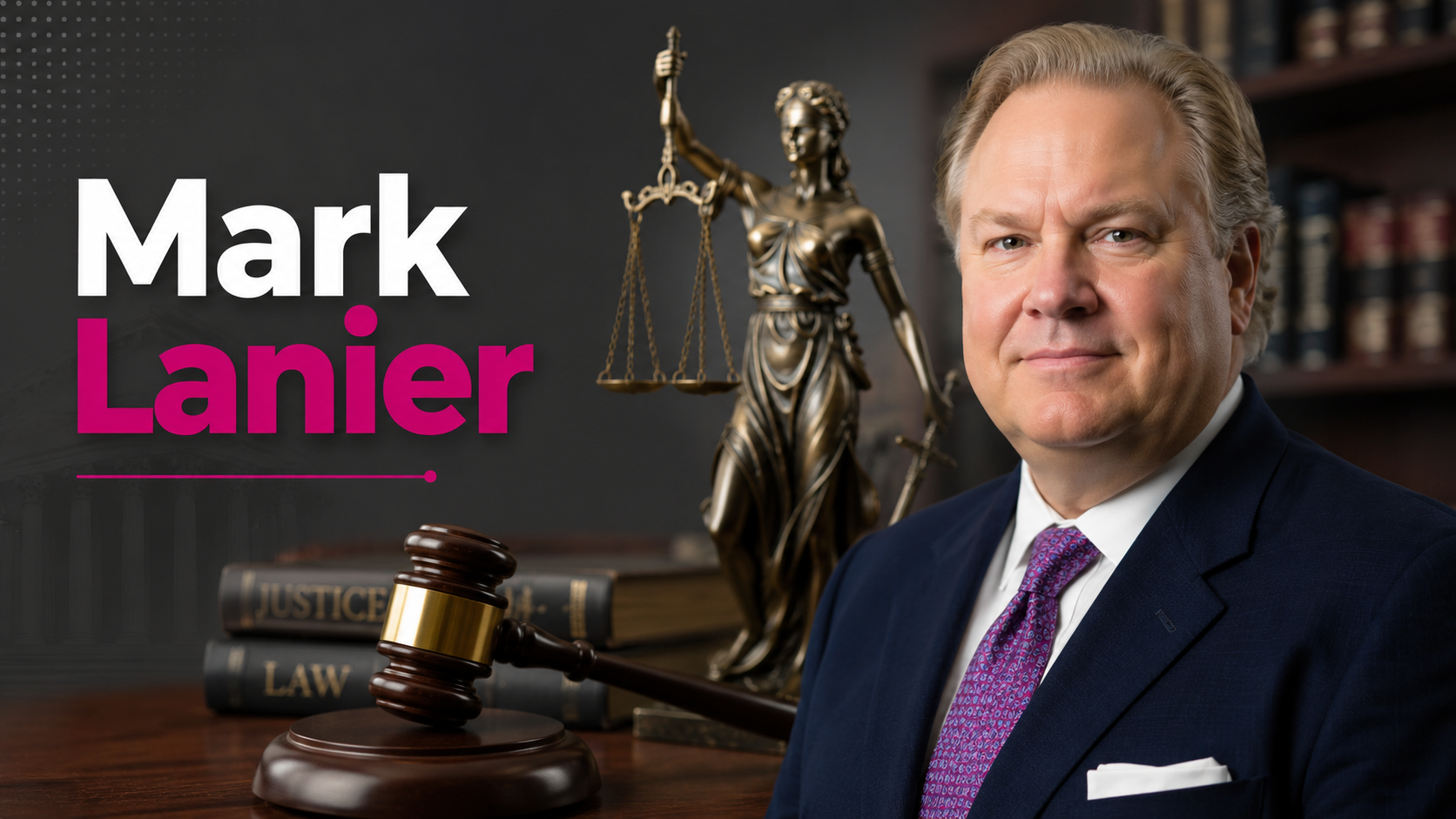
Twenty billion dollars. That’s roughly what Mark Lanier has won for his clients over a career that started in a small Houston firm and grew into one of the most feared plaintiff’s practices in the country. He’s beaten Merck, Johnson & Johnson, and Meta. He’s taken on pharmacy giants and won. And through it all, he’s kept teaching Sunday school to a congregation of hundreds.
This guide breaks down who Mark Lanier actually is: how he built The Lanier Law Firm, the landmark cases that made him a household name in legal circles, the trial strategy behind his verdicts, and why law schools keep asking him to lecture. Whether you’re a law student trying to understand mass tort litigation or a legal professional studying courtroom strategy, here’s the full picture.
Who Is Mark Lanier?
W. Mark Lanier is a Houston-based trial attorney and founder of The Lanier Law Firm, a plaintiff-side litigation practice with offices in Houston, New York, and Los Angeles. He’s spent more than four decades in courtrooms, and he’s not shy about the number. “I have been trying cases for 42 years,” he told Law.com in 2026. “I know we’re in the hundreds.”
He earned his undergraduate degree from David Lipscomb University in 1981, then his Juris Doctor from Texas Tech University School of Law in 1984. From there, he did what a lot of ambitious young lawyers do: he started at a big firm. He began his career at Fulbright & Jaworski in Houston, then moved to a smaller trial practice firm, Ernest Cannon and Associates, before deciding he wanted to build something of his own.
That decision paid off. Today, The Lanier Law Firm has grown into a firm with dozens of attorneys, and Lanier himself is regularly named one of the top trial lawyers in America by The National Law Journal, Chambers USA, and Best Lawyers.
The Founding of The Lanier Law Firm
Lanier formed The Lanier Law Firm in June 1990. He was still in his twenties. The firm started small and grew case by case, largely on the strength of Lanier’s ability to win in front of juries, not just settle. triallawyerportraits
That reputation didn’t happen overnight. It took years of grinding trial work before Lanier landed the case that would put him on the national map.
The Case That Made Him Famous: Vioxx v. Merck
If you want to understand why Mark Lanier’s name carries weight, start here.
In 2004, Merck pulled its blockbuster arthritis drug Vioxx from shelves after its own clinical testing showed the drug increased the risk of heart attack and stroke. Thousands of lawsuits followed. Nobody expected the very first case to go the plaintiff’s way.
Lanier represented Carol Ernst, whose husband Robert, a personal trainer and former marathon runner, died in his sleep after taking Vioxx for about eight months. Merck argued Robert Ernst died from clogged arteries, not a Vioxx-induced heart attack. On paper, it was a tough case for the plaintiff.
Lanier didn’t back down from that weakness. Instead, he leaned into Merck’s internal documents. He targeted former Merck CEO Ray Gilmartin, a “Harvard-trained businessman” who Lanier said turned the company into “an ATM machine that’s spitting out money.” He argued Merck downplayed safety concerns to keep Vioxx sales flowing after patents on other drugs expired.
The jury wasn’t just persuaded. They were angry. As one journalist covering the trial put it: “The jury was so angry with the documents that it saw, documents from inside Merck, emails from inside Merck, that it essentially decided that Merck needed to be punished.”
The result: a $253 million verdict, including $229 million in punitive damages, later reduced to $26.1 million under Texas damage caps.
It was August 2005, and Mark Lanier had just beaten one of the largest pharmaceutical companies on earth in the very first trial of the litigation. He went on to win additional Vioxx verdicts, and The Lanier Law Firm ultimately “played a significant role leading up to the $4.85 billion nationwide settlement” Merck announced to resolve the bulk of the remaining cases.
Why the Vioxx Case Still Matters
Law students still study this trial for a reason. It demonstrated something that would become a Lanier signature: you don’t win a hard case by avoiding its weaknesses, you win it by making the jury care more about the defendant’s conduct than about the plaintiff’s medical uncertainty.
That approach would show up again and again over the next two decades.
The Actos Verdict: A Record-Setting $9 Billion
Nine years later, Lanier topped himself. In 2014, he secured a verdict of just over $9 billion against Takeda Pharmaceutical and Eli Lilly over the diabetes drug Actos, which plaintiffs alleged caused bladder cancer. At the time, it stood as the highest punitive damages award ever handed down in a products liability case.
That verdict alone tells you something about the scale Lanier operates at. Most trial lawyers spend a career chasing a single headline-making verdict. Lanier has collected several.
The Johnson & Johnson Talc Trial: $4.69 Billion and a Piece of Cheese
This might be the single most talked-about trial of Lanier’s career, not just for the number, but for how he got there.
In July 2018, a St. Louis jury awarded $4.69 billion to 22 women and their families, represented by The Lanier Law Firm, after finding that decades of daily use of Johnson & Johnson’s asbestos-laden talcum powder caused their ovarian cancer. The verdict included $550 million in compensatory damages and $4.14 billion in punitive damages.
It was, and remains, a landmark case. It was one of the first times lawyers successfully argued that Johnson & Johnson’s Baby Powder and Shower to Shower talcum powder contained asbestos.
How did Lanier prove asbestos exposure to a jury of laypeople? He accused J&J of rigging tests for asbestos in its products and hiding evidence of asbestos for over four decades. But the accusation alone wasn’t what won the case. It was how he made it visual.
Midway through trial, Lanier pulled a knife from his pocket and held it over a large block of yellow cheese, using it to physically demonstrate how talc is mined from the earth. In its post-trial motion for a new trial, Johnson & Johnson complained about a hand-drawn slide Lanier used showing a woman being pushed off a cliff by a figure labeled “J&J Asbestos Baby Powder.”
That’s courtroom strategy in action: take a scientifically complex concept most jurors have never encountered (asbestos mining, mineral contamination, decades-old internal test data) and turn it into something they can literally see happen in front of them.
The verdict held up. In 2025, an appellate court upheld $2.11 billion of the original $4.69 billion judgment in an 83-page opinion, and the U.S. Supreme Court later denied Johnson & Johnson’s petition to review the case.
Holding Pharmacy Giants Accountable: The Opioid Verdict
By 2021, the opioid epidemic had killed roughly half a million Americans over two decades, according to figures Lanier cited during trial. Thousands of lawsuits had been filed against drug manufacturers and distributors. But almost nobody had gone after the pharmacies themselves.
Lanier changed that.
Representing Lake and Trumbull Counties in Ohio, Lanier led the trial team in a federal case in Cleveland against CVS, Walgreens, and Walmart. Roughly 80 million prescription painkillers were dispensed in Trumbull County alone between 2012 and 2016, equivalent to 400 pills for every resident. In Lake County, some 61 million pills were distributed in that same period.
After six weeks of testimony, the jury took more than five days to deliberate before returning a unanimous verdict finding all three pharmacy chains had substantially contributed to the crisis. It was the first time the retail segment of the drug industry had been held accountable in the epidemic.
Lanier’s reaction captured what made the case matter beyond the dollar figure: “The jury’s decision sounds a bell that should be heard by pharmacy companies around the country.”
The eventual payout was expected to top a billion dollars, possibly reaching $2 billion. More importantly, it opened the door for other counties and cities to pursue similar claims against pharmacy retailers nationwide, a shift in plaintiff counsel strategy that reshaped how opioid litigation unfolded across the country.
Meta, YouTube, and the Future of Product Liability
Lanier’s most recent headline win shows he’s still adapting to new frontiers of harm. Most recently, Mark led a trial team that secured a jury verdict totaling $6 million in compensatory and punitive damages for an individual plaintiff against Meta and Google’s YouTube, in what’s been described as the first social media addiction lawsuit trial in the nation, holding the platforms liable for addictive design features that harmed a young user’s mental health.
This case is worth watching closely, because it extends product liability theory into genuinely new territory: arguing that a digital platform’s design choices, not just a physical product, can constitute a defective and dangerous product.
What makes this case notable beyond the verdict itself is how Lanier prepared for it. He used a custom AI system, built on a platform called Boodlebox that combines multiple large language models, to create a custom license tailored to incorporate his 42 years of trial experience into the AI’s context. At the end of each court day, his team fed that day’s transcripts into different AI models for evaluation, and Lanier used the tool to find sharper, more persuasive ways to phrase courtroom arguments in real time.
It’s a glimpse at where legal education and courtroom practice are headed together: even a lawyer with four decades of trial experience is finding new tools to sharpen his craft.
What Makes Mark Lanier’s Trial Strategy Different?
Ask any legal observer why Lanier wins so consistently, and you’ll hear some version of the same answer: he makes jurors feel the case, not just understand it.
A few patterns show up across his biggest wins:
- He turns documents into narrative. In the Vioxx case, internal Merck emails became a story about corporate greed overriding patient safety.
- He uses physical demonstrations. The cheese-and-knife moment in the J&J talc trial wasn’t a gimmick; it gave jurors a mental image they could carry into deliberations.
- He picks unlikely opponents. Suing pharmacies, not just drug manufacturers, for the opioid crisis was a novel legal theory. So was arguing that a social media platform’s design is a defective product.
- He treats juries as people, not a formality. As one profile noted, “Jurors often vote for who they like. It’s why so many corporations hate to step in a courtroom.”
This is also why law schools keep inviting him back. Lanier serves as a featured lecturer at Harvard Law School, Stanford Law School, Pepperdine University School of Law, University of Chicago Law School, and Texas Tech University School of Law. In 2025, he delivered the inaugural lecture in Case Western Reserve University School of Law’s Anatomy of a Trial series, and he headlines his own Lanier Trial Academy each summer for more than 1,000 plaintiffs’ lawyers.
If you’re a law student or a junior litigator studying courtroom strategy, his lectures and case files are some of the most instructive material available, precisely because he’s willing to explain not just what he argued, but why it worked on a specific jury.
Beyond the Courtroom: Faith, Philanthropy, and the Lanier Theological Library
Lanier’s public identity isn’t only about verdicts. He’s also a serious student of theology, and that side of his life runs deep.
He holds a B.A. in Biblical Languages from David Lipscomb University and has taught a weekly Bible study called Biblical Literacy for more than 20 years at Champion Forest Baptist Church in Houston, to a class of more than 750 members.
In 2010, he founded the Lanier Theological Library, a 17,000-square-foot, non-circulating research library in northwest Houston, which he designed by combining his favorite architectural features from the libraries in and around the University of Oxford. The library hosts lectures from world-renowned theologians and scholars, and it’s since expanded into a broader learning center offering courses in Hebrew, Greek, and theology.
He’s also a published author. His books examining faith include Christianity on Trial (2014), Atheism on Trial (2022), and Religions on Trial (2023), along with a series of devotionals published by Baylor University Press.
His philanthropic work extends internationally, too. In 2009, Lanier founded Guatemala SANA, a nonprofit that brings health care, education, and infrastructure development to rural areas of Guatemala, work that earned him the Ambassador of Peace Award from the Guatemalan government in 2011.
Recognition and Honors
The accolades have piled up steadily over four decades. A partial list:
- Named Trial Lawyer of the Year for 2018 by both The National Law Journal and The Best Lawyers in America.
- Twice named National Trial Lawyers Association’s Trial Lawyer of the Year, and inducted into its Hall of Fame.
- Honored with Lifetime Achievement Awards from both the American Association of Justice and American Lawyer Media.
- Twice named one of the nation’s Top 10 Trial Attorneys by The National Law Journal, and included on its list of the 100 Most Influential Lawyers in America.
- Described by The New York Times as “one of the top civil trial lawyers in America”.
Frequently Asked Questions
Who is Mark Lanier?
Mark Lanier is a Houston-based trial attorney and founder of The Lanier Law Firm, known for winning some of the largest jury verdicts in U.S. legal history against companies like Merck, Johnson & Johnson, and Meta.
What are Mark Lanier’s biggest court cases?
His most notable wins include the 2005 Vioxx trial against Merck ($253 million), the 2014 Actos verdict against Takeda and Eli Lilly (over $9 billion), the 2018 Johnson & Johnson talcum powder trial ($4.69 billion), the 2021 opioid verdict against CVS, Walgreens, and Walmart, and the 2026 social media addiction verdict against Meta and YouTube.
When did Mark Lanier start The Lanier Law Firm?
He founded The Lanier Law Firm in June 1990, after beginning his career at Fulbright & Jaworski and then a smaller Houston trial practice.
What is Mark Lanier’s trial strategy known for?
He’s known for turning complex evidence into simple, visual narratives, using physical demonstrations in the courtroom, and building emotional connections with juries rather than relying purely on technical argument.
Does Mark Lanier teach law?
Yes. He lectures regularly at law schools including Harvard, Stanford, and the University of Chicago, and he runs his own Lanier Trial Academy each summer for more than 1,000 plaintiffs’ lawyers.
What is the Lanier Theological Library?
It’s a private theological research library Lanier founded in 2010 in Houston, designed around Oxford’s library architecture, that hosts lectures by prominent theologians and now includes an academic learning center.
How much has Mark Lanier won for his clients?
Cumulatively, his verdicts and settlements over his career put him close to $20 billion.