
 By Tort Law Team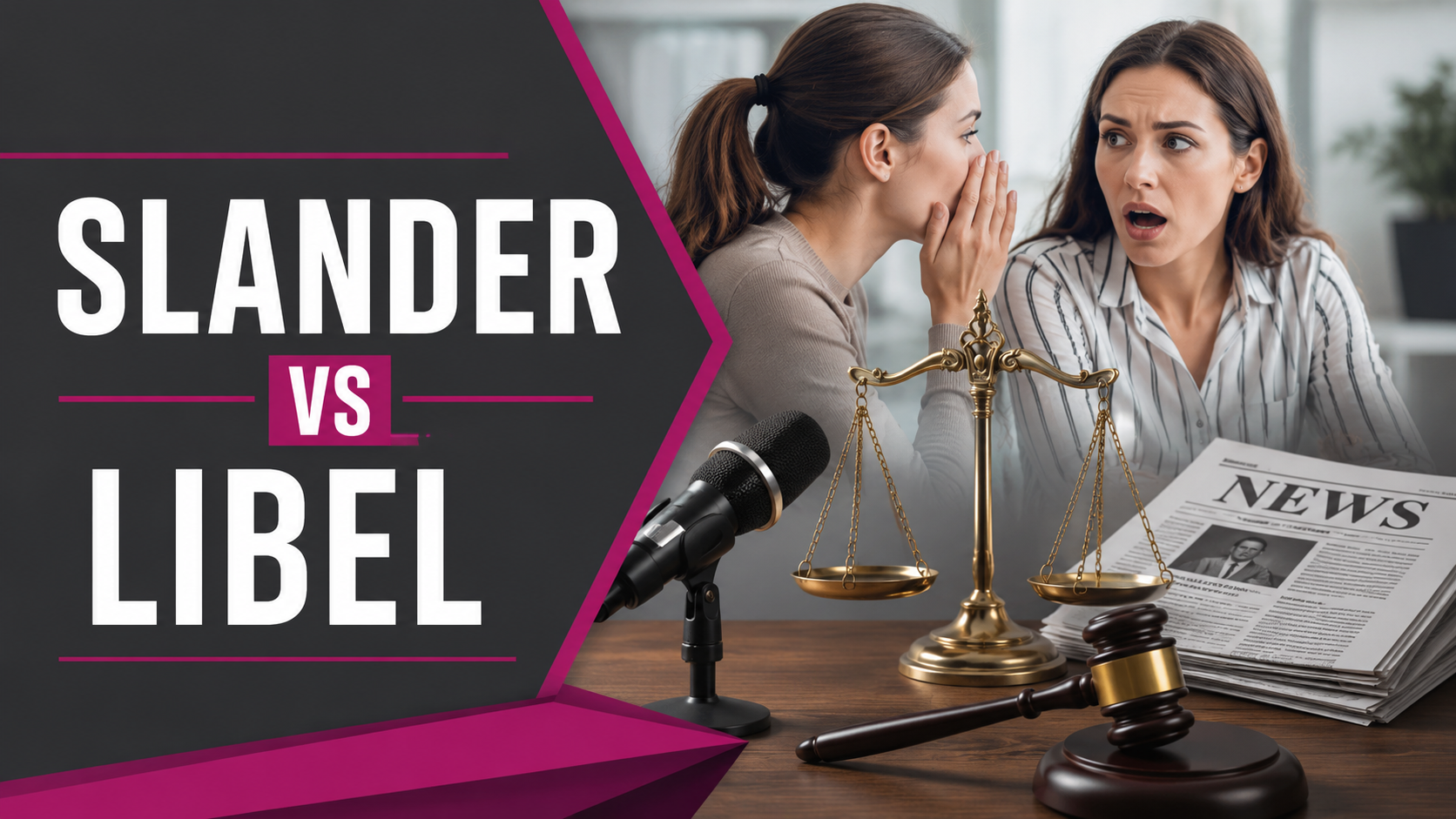
A single false accusation can tank a career, destroy a business, or leave lasting scars on a reputation. Whether it spreads through a whispered conversation or a viral social media post, the legal system treats these harms under the umbrella of defamation law. Understanding the distinction between spoken and written forms is essential if you want to protect yourself or respond effectively.
This guide breaks down slander vs libel in clear, practical terms. You will learn the core legal differences, how each is proven in court, available defenses, potential remedies, and concrete steps to take if you face reputational damage. The goal is simple: give individuals, business owners, content creators, journalists, and corporate leaders the knowledge needed to navigate these claims with confidence.
What Is Defamation Under Tort Law?
Defamation is a civil wrong, or tort, that protects a person’s reputation from false statements of fact. At its core, it requires a false statement presented as fact (not pure opinion), communicated to at least one third party, and causing harm to the target’s reputation or livelihood.
Courts generally require the plaintiff to prove several elements:
- The defendant made a false statement of fact.
- The statement was “of and concerning” the plaintiff.
- The statement was published or communicated to a third party.
- The defendant acted with the required level of fault (negligence for private figures in most cases, or actual malice for public figures).
- The statement caused reputational damage or other compensable harm.
These principles come from common law traditions refined by constitutional free speech protections. Landmark decisions such as New York Times Co. v. Sullivan (1964) raised the bar for public officials and public figures, requiring proof of actual malice (knowledge of falsity or reckless disregard for the truth).
Defamation falls into two main categories based on the form of the statement: libel for written or permanent forms and slander for spoken ones. This classification still matters for how harm is proven and what damages are available.
Libel Explained: Written and Permanent Defamation
Libel refers to defamation in a fixed or permanent medium. Classic examples include newspaper articles, books, letters, emails, blog posts, social media updates, online reviews, and even certain visual images or memes that convey a false factual claim.
Courts treat written statements as more serious in many respects because they last longer, can be copied and shared widely, and leave a clear record. A defamatory tweet, LinkedIn post, or online review can reach thousands of people within hours and remain searchable for years.
Modern technology has expanded what counts as libel. Broadcast statements on television or radio are often treated as libel rather than pure slander because of their broad reach and recording. Social media posts almost always fall under libel analysis for the same reason.
In many jurisdictions, a plaintiff who proves libel does not always need to show specific financial loss. Harm to reputation is often presumed, especially when the statement qualifies as libel per se. Common per se categories include false accusations of criminal conduct, having a loathsome or contagious disease, serious sexual misconduct, or unfitness in one’s profession or business.
Slander Explained: Spoken Defamation
Slander covers defamatory statements made orally. This includes face-to-face conversations, speeches, phone calls, podcasts that are not permanently recorded in a fixed form, or live unscripted remarks.
Because spoken words are typically more fleeting, the law historically treated slander as less inherently damaging than written statements. As a result, plaintiffs in ordinary slander cases usually must prove special damages. Special damages mean concrete, quantifiable economic losses, such as lost customers, a terminated job, a canceled contract, or other measurable financial harm directly caused by the statement.
There is an important exception: slander per se. When a spoken statement falls into the same highly damaging categories listed above (crime, disease, sexual misconduct, or professional unfitness), courts often presume harm. The plaintiff does not need to prove special damages to recover.
Proving the content of a spoken statement can be harder than proving a written one. Witnesses, recordings, or contemporaneous notes become critical evidence.
Key Differences Between Slander and Libel
The primary distinction is the medium: written or permanent form versus spoken. Several practical consequences flow from that difference.
Permanence and Reach
Written statements create a lasting record that can spread farther and faster. Spoken statements often disappear once the conversation ends, although modern recording devices and livestreams complicate this traditional view.
Burden of Proof on Damages
Libel plaintiffs frequently benefit from a presumption of harm. Slander plaintiffs ordinarily must prove special damages unless the statement qualifies as per se. This difference makes many pure slander cases more difficult to win.
Evidence Challenges
A written post, email, or article is easy to preserve and present in court. A spoken remark may require multiple witnesses whose memories can be challenged.
How Courts Classify Modern Media
Social media posts, emails, text messages, and most online content are treated as libel. Unscripted live broadcasts or pure oral conversations remain closer to traditional slander, though courts sometimes look at the overall impact and permanence.
Technology continues to blur the old bright-line rules. A viral video of a spoken accusation may be analyzed under libel principles because of its recording and wide distribution.
Proving Slander vs Libel in Court
Success in either type of claim depends on satisfying the core elements of defamation law while meeting the specific requirements for the form involved.
Establishing Falsity and Fault
The plaintiff must show the statement was false. Truth is an absolute defense. For private figures, many states require only negligence (failure to exercise reasonable care in checking facts). For public officials and public figures, the higher actual malice standard applies. That standard demands clear and convincing evidence that the defendant knew the statement was false or acted with reckless disregard for the truth.
Publication Requirement
The statement must reach at least one person other than the plaintiff. A private conversation between two people that no one else hears generally does not satisfy publication. A group chat, public speech, or social media post clearly does.
Causation and Harm
The false statement must cause reputational injury or other compensable damage. In libel and per se cases, general damages for reputational harm are often available without detailed financial proof. In ordinary slander cases, special damages (specific economic losses) are usually required first.
Real-World Examples
Imagine a competitor tells potential clients at a networking event that your company is under criminal investigation for fraud when no such investigation exists. That is classic slander. If the same false claim appears in a blog post or email newsletter, it becomes libel. Both can support a lawsuit, but the evidence and damages analysis will differ.
Another common scenario involves social media. A content creator posts a video claiming a rival influencer stole content and committed fraud. Courts almost always treat the posted video and accompanying text as libel because of the permanent digital record.
Available Legal Defenses
Defendants have several strong tools to defeat defamation claims.
Truth Defense
Truth is a complete defense. Even if the statement is damaging, a defendant who can prove the essential substance is true usually prevails. Courts often accept “substantial truth.” Minor inaccuracies that do not change the overall defamatory sting do not defeat the defense.
Opinion and Fair Comment
Pure opinions that do not imply false underlying facts are protected. Statements such as “I think this product is terrible” generally cannot support a claim. However, statements framed as opinion that imply undisclosed defamatory facts can still be actionable.
Privilege
Absolute privilege protects statements made in certain official settings, such as judicial proceedings, legislative debates, or some executive communications. Even knowing falsehoods may be shielded in these contexts.
Qualified privilege applies in situations where the speaker has a legitimate interest or duty to communicate the information, such as an employer providing a job reference or a citizen reporting suspected crime to authorities. The privilege can be lost if the defendant acts with malice or exceeds the scope of the privilege.
Other Protections
Fair report privilege often protects accurate accounts of official proceedings. Anti-SLAPP statutes in many states allow early dismissal of lawsuits that target protected speech on public issues and can shift attorney fees to the losing plaintiff.
Damages and Remedies in Defamation Cases
Successful plaintiffs may recover several types of damages.
General damages: compensate for reputational harm, emotional distress, and humiliation. These are often available in libel and per se cases without proof of specific economic loss.
Special damages: cover quantifiable financial losses such as lost income, lost business opportunities, or medical expenses related to the emotional impact.
Punitive damages: may be awarded when the defendant acted with actual malice or extreme recklessness. These are designed to punish and deter.
Some jurisdictions also allow nominal damages when liability is proven but measurable harm is hard to quantify. Injunctive relief (court orders requiring removal of content or prohibiting further statements) is sometimes available, though free speech concerns limit its use.
High-profile cases illustrate the financial stakes. Verdicts in the tens or hundreds of millions of dollars have been returned in recent years when juries find sustained campaigns of false statements, especially involving public figures and proven actual malice.
Practical Guidance: How to Respond to Defamatory Claims
Whether you are the target of false statements or someone has accused you of defamation, a measured response improves outcomes.
If You Are the Target
Document everything immediately. Save screenshots, recordings, emails, and witness contact information. Do not delete evidence. Consider sending a carefully worded demand letter requesting retraction or removal. In some states, a timely retraction can limit recoverable damages.
Assess whether the statement is truly false and whether it caused actual harm. Not every insult or harsh review rises to actionable defamation. Consult a lawyer experienced in reputational damage claims before filing suit. Many cases settle or are resolved through demand letters and platform reporting tools.
Platforms such as major social media companies have their own reporting processes for defamatory content. Using those tools in parallel with legal steps can lead to faster removal.
If You Face a Claim
Preserve all relevant communications and evidence supporting the truth of your statement or any privilege. Avoid making further statements that could aggravate damages. Early legal advice is critical, especially if anti-SLAPP statutes apply in your jurisdiction.
Journalists and content creators should maintain strong fact-checking practices and document sources. Businesses should train employees on careful communication, particularly in performance reviews, customer complaints, and public responses.
Prevention Strategies
Stick to verifiable facts. Label opinions clearly. Avoid absolute statements about criminality, disease, or professional incompetence unless you have solid evidence. When reporting on others’ statements, consider fair report principles and accurate attribution.
For more on related procedures, see our guide on how to respond to online defamation claims and steps for documenting reputational harm. External resources such as the Legal Information Institute at Cornell Law School offer accessible overviews of defamation principles.
Social Media Defamation and Modern Challenges
Online platforms have transformed slander vs libel analysis. A single post can reach a global audience instantly and remain available indefinitely. Courts consistently treat social media content as libel because of its written, permanent nature.
Anonymous posters create additional hurdles. Subpoenas and platform cooperation are often needed to identify defendants. Section 230 of the Communications Decency Act generally shields platforms from liability for user-generated content, so claims usually target the individual poster rather than the site itself.
Content creators and brands face heightened exposure. A false review, coordinated attack, or viral accusation can cause rapid reputational damage. Monitoring tools, clear internal communication policies, and prompt legal consultation form the first line of defense.
Common Pitfalls to Avoid
Do not assume every negative statement is actionable. Opinions, hyperbole, and true statements are protected. Do not wait too long. Statutes of limitations for defamation are often short, sometimes one or two years from publication.
Avoid escalating the situation with retaliatory statements that could create a counterclaim. Do not rely solely on platform takedowns if serious economic harm has occurred. Legal action may still be necessary.
Jurisdiction matters. Defamation law is primarily state law, and standards for public versus private figures, damages, and privileges vary. Multi-state or international online statements can raise complex choice-of-law questions.
Conclusion
The distinction between slander and libel remains a foundational concept in defamation law. Libel involves written or permanent statements and often carries a presumption of harm. Slander involves spoken statements and typically requires proof of special damages unless the words qualify as per se. Both require a false statement of fact, publication, fault, and resulting injury. Strong defenses including truth, opinion, and privilege protect free expression while still offering recourse for genuine reputational harm.
Armed with this knowledge, you can better evaluate potential claims, protect your own communications, and respond effectively when false statements threaten your personal or professional standing. Consult a qualified attorney familiar with the defamation rules in your jurisdiction to evaluate any specific situation and determine the best path forward.
Frequently Asked Questions
What is the main difference between slander and libel?
Slander is spoken defamation. Libel is written or permanent-form defamation. The difference affects evidence and the need to prove special damages in many cases.
Can you sue for both slander and libel from the same incident?
Yes, if the same false statement is made both orally and in writing, separate claims may be possible depending on the facts and jurisdiction.
Is a social media post considered slander or libel?
Social media posts are almost always treated as libel because they are written and permanent.
What damages can you recover in a defamation case?
Plaintiffs may seek general damages for reputational harm, special damages for specific economic losses, and in some cases punitive damages when actual malice is shown.
Is truth always a complete defense?
Yes. Substantial truth is a complete defense to both slander and libel claims in the United States.
How long do you have to file a defamation lawsuit?
Statutes of limitations vary by state but are often one to three years from the date of publication. Check the specific rules in the relevant jurisdiction promptly.
Do public figures have a harder time winning defamation cases?
Yes. Public officials and public figures must usually prove actual malice by clear and convincing evidence, a significantly higher standard than the negligence standard often applied to private figures.
You May Also Like: What Is Defamation? A Clear Guide to Your Legal Rights